
Before diving in, try to read this sentence: “Rain stopped play just after the declaration, so the follow-on was never enforced.” You probably decoded every word but (unless you know cricket) have no idea what happened.
That’s the experience many students have every day. They’re in science classrooms, history books, and math lessons where they can read the words but not the meaning. It’s not a problem that phonics can fix; knowledge and language do. And the fastest way to give students both of those is through their ears.
This guide is all about disciplinary literacy: the specific ways scientists, historians, mathematicians, experts, and writers read, write, and reason. Disciplinary literacy is the work of every secondary classroom, and print materials alone are rarely enough. Listening can open the door.
In this guide, you’ll find:
- What the latest national data says about the literacy crisis, and how that connects to a comprehension crisis
- What content area literacy and disciplinary literacy mean, and how they differ
- The research on why listening comprehension drives reading comprehension
- How the science of reading policy wave is turning toward older students and oral language
- Practical, research-backed ways to teach listening in any subject, including for English learners
- What we’ve seen in LingoLift classrooms (formerly Listenwise)
The literacy crisis is a comprehension crisis
If you spend your days in a classroom, the latest NAEP reading scores weren’t a shock. The latest data came back to confirm what teachers across the United States have been seeing. Scores in 4th grade and 8th grade slipped another two points from 2022, without a single state posting gains. By senior year, the divide has widened even further: top performers are holding steady, while the most vulnerable students are slipping further behind.
Numbers only tell part of the story. The real issue is why they’re struggling.
The NAEP ultimately tests whether a student can extract meaning from grade-level text. In practice, that’s a 4th grader who has a solid phonics foundation but can’t explain a character’s underlying motive. By the time that same student reaches high school, the expectations have skyrocketed. They are suddenly asked to interrogate historical documents, unpack scientific journals, and track evidence-based arguments. And they struggle.
You know exactly who these students are. You’ve likely met them. They can read a passage aloud seamlessly, but when asked what it means, they freeze or search for a one-size-fits-all answer. For a few, decoding is still the roadblock. But for many students, the words simply don’t land. They are sidelined by dense vocabulary, labyrinthine sentences, and a lack of background knowledge. The struggle is in English class, but also history, science, and math.
The Reading League’s Chief Academic Officer spotlighted this exact crisis in an October 2026 post. She described a classic seventh grader who decodes well enough to fly under the radar, only to stall out when texts demand deeper comprehension. She writes:
Reading difficulties can erode confidence, discourage class participation, and lead students to believe they are simply “not good enough.” … The reality is that the underlying issue is literacy.
Dr. Marisa Ramirez Stukey
Chief Academic Officer, The Reading League
These students are sitting in every classroom, yet most teachers were never given the specialized training they need to pin exactly where the literacy breakdown is happening. That invisible gap — between sounding out words and actually understanding them — is exactly what LingoLift is built to bridge.
If the problem is comprehension, the solutions have to reach for comprehension. And that’s where content area literacy, disciplinary literacy, and listening shape the path.
Content area literacy vs. disciplinary literacy
These two terms overlap, but they aren’t the same thing. Content area literacy focuses on general reading and writing strategies used to comprehend text regardless of subject, while disciplinary literacy focuses on specialized ways that experts within a specific field read, write, and think.
The best way to differentiate the two is with an example. Imagine a a social studies classroom where students are assigned to read a primary source document: a letter written by a factory worker during the Industrial Revolution.
What is content area literacy?
Here, the teacher’s goal is to help students comprehend the text. Strategies to achieve this will be general literacy strategies that could apply to a science textbook or a novel. Content area literacy is subject agnostic. Think: previewing headings, annotating, summarizing, and building vocabulary.
With our example, the teacher would ask students to highlight and look up unfamiliar words: “loom,” “cholera,” or “tenement.” After reading, students would write a one-paragraph summary of what the factory worker experienced. The teacher might introduce a graphic organizer like a Venn diagram to compare the worker’s life to our own lives today.
The goal is for students to identify main ideas, and find supporting details. (For strategies and examples, see our guide to content area literacy.)
What is disciplinary literacy?
Disciplinary literacy is narrower and deeper. Researchers Timothy and Cynthia Shanahan describe it as the shared ways of reading, writing, thinking, and reasoning within an academic field. A chemist reads for precise procedure, a mathematician reads every symbol as load bearing, and a historian reads a primary source asking who wrote it, when, and why.
In our example, the focus shifts from general comprehension to historical inquiry and critical analysis. Before reading the text, students will be asked to look at the author, date, and origin. They’re taught to ask: Who wrote this? What was their position in the factory? Why might they have written this letter?
This places the document in time and space. They can inquire deeper: What else was happening in 1840s England? How does knowing the Chartist movement change how we read this worker’s complaints? The teacher can provide a second document, like a report from the factory owner, for students to compare, analyze perspectives, and piece together a more accurate reality.
In disciplinary literacy, students go beyond the main idea. They’re taught analysis.
| Content Area Literacy | Disciplinary Literacy | |
|---|---|---|
| Core question | How do I learn from this text? | How does this field read, write, and argue? |
| Strategies | General, all subjects | Specific to each discipline |
| Typical moves | Preview, annotate, summarize, define terms | Source a document, evaluate evidence, read a procedure, interpret notation |
| Who leads it | Any teacher | The subject-matter teacher as the expert |
Strong secondary classrooms don’t choose between these: they combine both. General strategies get students started, and discipline-specific habits take them to the finish line.
Think of the two as a floor and a ceiling. Content area literacy is that floor: foundational vocabulary, background knowledge, and comprehension to get into the text. Disciplinary literacy is the ceiling: once they’re in, they can start asking questions of the text itself.
The trouble is time. Most teachers spend their planning hours, and much of class, just getting everyone onto the floor with the same foundations. We built LingoLift to cover a lot of that groundwork, leaving more room to reach for the ceiling.
How important is teaching literacy in all content areas?
It’s essential. Most of what students read, hear, and write in secondary school happens in the language of science, math, and history. Students who can’t comprehend those texts can’t access the content. Literacy instruction in every subject is how content becomes learnable.
Compared to a decade ago, three reasons make this integration even more urgent:
1. Knowledge drives comprehension.
In a 1988 study, Donna Recht and Lauren Leslie tested 7th and 8th graders on a passage about baseball. Students who knew a lot about baseball understood the passage well, regardless of their general reading ability (Shanahan on Literacy). While researchers still debate how far to stretch that finding, few dispute the core point: what students already know shapes what they can understand. Science and social studies classrooms are where most of that knowledge gets built.
2. Text demands climb steeply after elementary school.
The jump from “learning to read” to “reading to learn” is really a jump into many specialized languages at once. A 9th grader may face a lab procedure, a primary source, and a word problem all before lunch. Each one reads differently.
3. Every class now holds a wider range of readers.
Newcomers, long-term English learners, students with IEPs, and students still recovering from interrupted schooling share rooms with strong readers. A content teacher cannot assume everyone can read the textbook independently.
That’s the meaning behind every classroom is a literacy classroom. Every teacher can give students a way into the texts of their field. The way we’ve found is through their ears.
Why listening is the key that opens the door to literacy
If you’ve done any science of reading training, you know this model already. It’s worth a second look with listening in mind.
The Simple View of Reading puts listening at the center
In 1986, Philip Gough and William Tunmer proposed that reading comprehension is the product of two things: decoding and language comprehension. When researchers tested the model, they measured that second piece by having students listen to a passage and answer questions about it. Because the two multiply, a student who’s strong in one and weak in the other still won’t understand what they read. Once decoding is fluent, though, reading comprehension tends to follow listening comprehension pretty closely.
That happens early. Tiffany Hogan, Suzanne Adlof, and Crystle Alonzo reviewed the research and found that listening comprehension becomes the bigger influence on reading comprehension starting in elementary school. They also pointed to a growing group of “poor comprehenders”: students who decode just fine, but whose reading comprehension lags, mostly because their listening comprehension does.
That’s the scenario behind the data we shared earlier, and stronger oral language helps.
Students understand more by ear than by eye for years
For most of school, students can follow harder material by listening than by reading. A 1984 meta-analysis by Thomas Sticht and J. James found that listening comprehension stays ahead of reading comprehension until middle school, or grades 6 to 8. The Common Core’s appendix on speaking and listening cites it, and Reading Rockets makes the point that oral language work doesn’t stop at kindergarten.
In practice, listening lets students meet grade-level ideas, vocabulary, and sentence structures before their independent reading catches up. They get the knowledge now, and that knowledge makes reading easier later.
For multilingual students, oral language is the bridge
Some of the strongest evidence comes from research with English learners. The National Literacy Panel on Language-Minority Children and Youth reviewed nearly 2,000 documents for its 2006 report. One of its clearest findings was that oral English matters most for the higher-level work: students with well-developed oral English tend to have strong reading comprehension and writing. Without it, multilingual students can learn to decode on pace and still fall behind later in comprehension and vocabulary.
That’s a lot of our students. About 1 in 10 U.S. public school students is an English learner, and in Texas, it’s been closer to 1 in 5 as of June 2026.
Listening isn’t the whole program
Listening and reading are related, not identical. LingoLift was built with the understanding that strong listening doesn’t automatically turn into strong reading without comprehension instruction.
We think of listening as the mechanism. It’s the key that opens the door. It builds the knowledge, vocabulary, and language that reading draws on, and then reading, writing, and speaking build their skills up. A strong literacy classroom uses all four domains. Listening is what puts the other three within reach for more of your students, and that’s why it’s the backbone of what we do.
Why hearing experts think out loud builds disciplinary literacy
We’ve established how listening gets students onto the floor, that foundation we talked about earlier. Expert voices help them reach for the ceiling.
Shanahan describes disciplinary literacy as getting students to take part, at a beginner’s level, in the way a field reads and talks. That talk is hard to find in a textbook, where doubt and debate are often edited out.
Interviews and reported stories put it back. Students get to hear:
- a historian say “the records suggest” instead of “we know,” and explain why
- a scientist separate what the data shows from what she suspects
- a reporter push back with a follow-up because the first answer didn’t directly address the question
- two experts disagree, politely, about what the evidence means (our “That’s Debatable” series is great for this!)
One ELD teacher who uses our lessons noticed the impact of these materials with her language learners. So much of the audio is conversation, and that allowed her students to hear how to start a discussion, how to ask a follow-up, and how to keep building on an idea, instead of stopping after one question for one answer.
Explainers and expert stories do different jobs
There’s need for both in a content classroom, so we have both. A good explainer video is built to get information across clearly and quickly; these are a great fit for content area literacy work like front-loading vocabulary and building background.
Reported stories, editorials, and interviews show how knowledge gets made. There’s a real person with a point of view, and something worth questioning. That’s what gets a class talking, and it’s why we describe so many LingoLift lessons as stories that spark conversation.
In a lesson
When the lesson’s scaffolds take care of the floor (key vocabulary, comprehension questions, a transcript), you can spend discussion time on questions like these:
- How does she know that? What’s her evidence?
- What would change their mind?
- Who else should we hear from before we decide?
- How would a scientist, a historian, or a mathematician check this claim?
Policy changes, and why the science of reading is moving up the grades
For the last decade, literacy policy has mostly been about K-3. Lately, the conversation has widened to older students and to the language side of the Simple View.
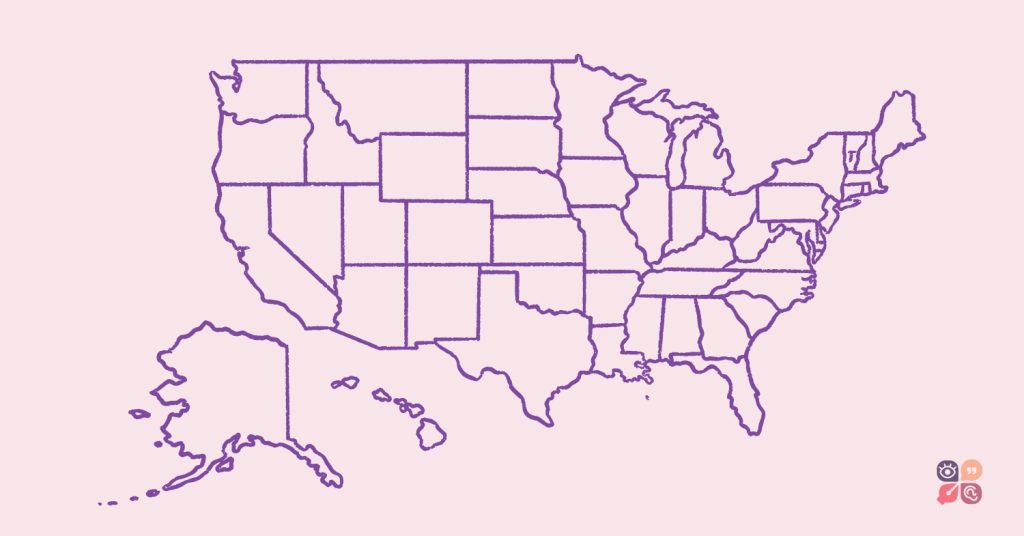
Most states are already on board with changes. As of March 2026, 42 states and D.C. had passed laws or policies on evidence-aligned reading instruction. (You can check out EdWeek’s tracker as cited by The Reading League.) Most of those changes are focused on foundational skills, screening, and teacher training in the early grades.
Middle school is next. ExcelinEd’s 2026 policy outlook noted that those early-grade gains haven’t carried into the middle grades, where reading results have stalled. It expects more states to build K-8 systems that include language comprehension and background knowledge across subjects. Virginia has already extended its literacy supports through 8th grade.
Federal policy is also incorporating oral language, by name. On September 16, the House passed the Science of Reading Act of 2026 (H.R. 7890), which would steer federal literacy grants toward science-of-reading-aligned instruction. In its statement on the vote, The Reading League noted that the bill recognizes oral language, background knowledge, and the reading-writing connection. It still has to get through the Senate.
California wrote oral language into law. AB 1454, signed October 9, 2025, defines effective literacy instruction as explicit foundational skills plus attention to oral language, vocabulary, background knowledge, and comprehension, with tiered supports for English learners and students with exceptional needs. The state put $200 million toward training, and the law covers roughly 1.1 million English learners.
Over in Texas, the bar is being raised for materials. Under HB 1605, instructional materials go through a new state board review, and approved materials have to reflect evidence-based practice in reading language arts, math, science, and social studies.
What these changes mean for your classroom
While the details vary by state, the direction that education is moving in is consistent. Policy is shifting from teaching every student to decode toward teaching every student to comprehend, in every grade and subject. That puts listening, vocabulary, and knowledge-building in content classes squarely inside evidence-aligned practice.
If you teach science or social studies, it’s worth keeping in mind that the knowledge-building you already do counts as literacy work. Listening is one of the most efficient ways to do more of it.
How to teach listening in any subject
Students spend a lot of the school day listening, from 50% to 75% of the day. However, a Chartered College of Teaching review notes that listening has historically gotten the least attention from teachers and researchers, even though teaching listening strategies reliably improves comprehension. (Think back to your own teacher prep. Was there a listening methods course?)
These are our tips for introducing listening strategies. If you already teach reading comprehension, this should feel familiar. You build background, give students a reason to listen, support them during the text, and ask them to do something with it afterward.
How to teach listening comprehension: before, during, and after
Before you press play (3 to 5 minutes):
- Ask one open question about the topic. Students can answer with a word, a quick sketch, or in their home language.
- Preview three to five key words with pictures. Pick words they need for this story and will see again later in the unit.
- Put one or two questions on the board so students know what they’re listening for.
While they listen (two or three plays):
- First listen, for the gist: “What’s this mostly about?”
- Second listen, for details. Pause after key sentences and have students fill in a cloze sentence, jot a note, or tell a partner what they heard.
- Third listen, for language. Replay a sentence with a target word, or a structure that belongs to your subject, like the way a scientist states a cause or a historian hedges a claim. Have students repeat it or borrow it.
A read-along transcript helps a lot at first. Fade it as students get stronger, or as test season gets closer, so they’re relying on their ears.
After listening (5 to 10 minutes):
- Everyone talks to at least one partner about the story.
- Then they write: a quick-write, a claim with one piece of evidence, or a response with a sentence starter.
- Then they read. Hand out the related textbook section or primary source, and let them go in with the knowledge, the vocabulary, and a question already in hand.
This is where you see the payoff. Students who might have stalled on the reading now have a way in.
Teach students to notice how they listen
Strong listeners plan ahead, check whether they’re following, and fix it when they lose the thread. Larry Vandergrift and Christine Goh built a whole approach around that cycle of planning, monitoring, problem-solving, and evaluating. Results with language learners have been promising, if not uniform.
You can borrow the core moves in a few seconds each:
- Predict: “From the title, what do you think we’ll hear?”
- Check: “Was your prediction right? What surprised you?”
- Fix: “Where did you lose track? Let’s replay that part.”
- Reflect: “What helped you follow it today?”
Over time, students start doing this on their own, and listening becomes something they manage instead of something that happens to them.
How to teach speaking and listening together
The quickest way to deepen what students understand is to have them say it out loud.
- Turn and talk. Ask a question, give 30 seconds, then call on pairs instead of individuals.
- Partner restate. One student answers, and their partner reports back what they said. One teacher we work with builds this into her weekly routine every Wednesday: students share with a partner, and the partner tells her what they said.
- Find the gist. Pairs agree on one sentence: who or what the story is about, and the most important thing it says about them.
- Debate. Use the opinion question that comes with the story, or turn the information from the video or podcast lesson as a debate prompt.
How to teach listening skills to ESL students
Everything above works for multilingual learners, and here are few things that make it work better:
- Let students use their home language to brainstorm, take notes, or try out an answer first.
- Point out cognates. For Spanish speakers, photosynthesis and fotosíntesis can be a free head start.
- Slow the audio down and replay it. That lowers the load without watering down the content.
- Offer sentence frames like “The story says ___ because ___.” They make speaking less scary and model academic grammar along the way.
- Pick content that fits their age. A 15-year-old newcomer should get a real story about science, not a picture book. Match the language load to their level and the ideas to their age.
- Give low-stakes ways to speak, like recordings or partner talk, before asking for whole-class answers. Many newcomers go quiet when they’re unsure how a word sounds.
Speaking time can be scarce for these students, with English learners spending as low as 5% of the school day speaking English. Every listening routine you choose to incorporate into your lessons gets some of that time back.
Try this 15-minute routine in your next lesson
| Minutes | Step | What students do |
|---|---|---|
| 0–3 | Hook | Answer one question about the topic; preview 3 key words with images |
| 3–6 | First listen | Listen for the gist; share it with a partner in one sentence |
| 6–9 | Second listen | Fill in 3 cloze sentences or answer the posted questions |
| 9–12 | Talk | Turn and talk on an opinion question; partner restates |
| 12–15 | Write | Quick-write: one claim, one detail from the story |
Classroom literacy strategies that start with listening
The reading literacy strategies that work best in content classes start before students open the text. In each subject below, the story does the groundwork, and the expert in it raises a question worth arguing about.
Science
Expert voice to listen to: A researcher describing a finding, including what’s still uncertain.
Disciplinary question it opens: How strong is the evidence, and what would change it?
Then read or write: The lab procedure or textbook section; a claim-evidence-reasoning paragraph.
Social Studies
Expert voice to listen to: A historian in an interview, or reporting that connects past to present.
Disciplinary question it opens: Who is the source, and what do they want us to believe?
Then read or write: A primary source; a short argument citing two sources.
Math
Expert voice to listen to: Someone who used math to solve a real problem, like an engineer or a data reporter.
Disciplinary question it opens: What assumptions did they make, and are they reasonable?
Then read or write: A word problem; a written explanation of the strategy used.
English Language Arts
Expert voice to listen to: An author interview, or a critic discussing a book.
Disciplinary question it opens: What choices did the writer make, and why?
Then read or write: The chapter; an analytical or argumentative paragraph.
ELD and Newcomer Classes
Expert voice to listen to: A short, slower story with images, a transcript, and a real speaker.
Disciplinary question it opens: What does the speaker think, and how do you know?
Then read or write: Cloze sentences, sentence frames, then an independent response.
A few more that work in any subject:
- Connect across classes. Pick stories that tie to what students are learning in their other classes, so the knowledge shows up in more than one room.
- Open a unit with a story. One teacher we know kicks off whole novel units this way, from James and the Giant Peach to Esperanza Rising.
- Pair audio with text, then separate them. Read-along transcripts help students connect spoken and written words. Later, try listening first and reading second, or the other way around.
- Make it a habit. Short, regular practice beats the occasional long session. Teachers we work with run a “Listening Wednesday” or a story every Tuesday.
- Turn the opinion question into writing. A quick-write today can become an argumentative essay next week.
- Let students make their own. After hearing good examples, students can script and record short podcasts about something they know well. That’s writing, speaking, and research in one project.
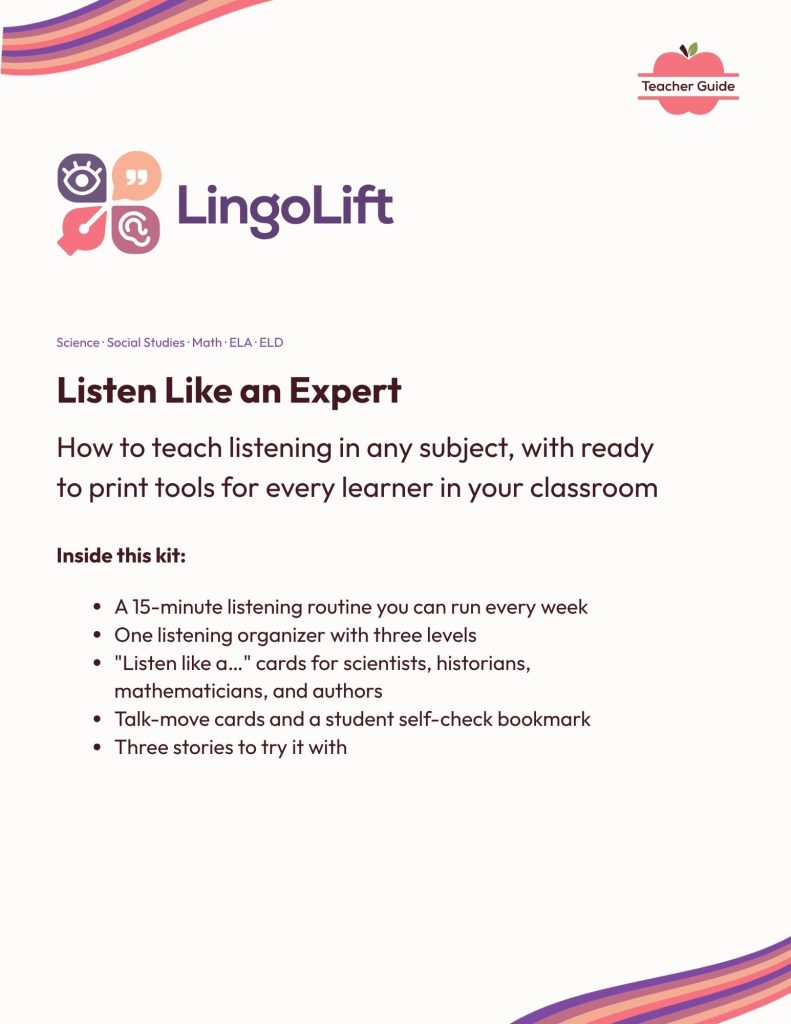
Free printable kit
How to Teach Listening: A Free Printable Kit for Any Subject
Everything in this post, ready to print! Run your first listening lesson tomorrow, in any subject. Includes:
- The 15-minute routine, on one page
- One listening organizer with three levels
- “Listen like a scientist / historian / mathematician / author” cards
- Talk-move cards and a self-check bookmark for students
8 pages · Grades 2–12 · No sign-up needed
What the evidence says about LingoLift (formerly Listenwise)
In 2026, Listenwise became LingoLift. Teachers have used us for years to teach listening across subjects. What they noticed, though, was how listening was opening the door to comprehensive literacy across all four domains. This led us to grow into the LingoLift we are now, with expanded activities that cover all four skills.
Here are the results we’ve seen with districts who used Listenwise.
Clovis Unified
When Clovis Unified started giving the CAASPP in 2015, listening stood out: fewer students scored above standard in listening than in reading, writing, or research (case study).
That year, one Clovis North High School teacher piloted our platform. His students’ listening scores went up 11 points the first year and 15 percentage points the next. By 2018, all twelve Clovis secondary campuses were using it. In 2019, the district had its best CAASPP listening results to date, with 29.77% of students above standard. Clovis expanded to all 50 campuses in 2021.
In 2024, listening scores dipped statewide, by 0.14 points for all students and 0.09 points for multilingual learners. Clovis went up: 0.47 points for all students and 0.60 for multilingual learners. These numbers moved in the right direction while the district was seeing its fastest-ever growth in multilingual students, including newcomers who speak more than 50 languages.
Sanger Unified
In Fresno County, Sanger Unified had persistently low listening scores on the CAASPP and ELPAC, so it piloted our platform with ten designated ELD teachers. After the pilot, the district signed on for 3 years, starting with ELD classrooms in grades 6 to 12 and adding integrated classrooms the second year (case study).
EL program specialist Theresa Blanchard described what surprised them:
“We were looking specifically to support our English learners first and foremost, but then through our implementation, we found out how useful it was for all of our students, EL or not.”
California districts, statewide
In early 2026, our team compared 2025 CAASPP and ELPAC results for California districts with at least one school using the platform against districts without it. Districts using our platform had a larger share of students exceeding the standard (17.51% higher), a larger share above standard on the listening claim, and a smaller share not meeting the standard.
While districts that choose a listening program might differ from other districts in plenty of ways, it’s these data points that motivate us to keep building and delivering real-world lessons for real students in real classrooms.
What teachers tell us
“Outstanding program for exposure to essential vocabulary and current events and improving listening skills to retain information. Does not increase teacher workload.”
” … my students that are struggling with decoding feel they are part of the greater reading discussions I know they want to participate in.”
“I receive close to 100% participation on any Listenwise assignment I give to my students.”
“It’s just as much a thinking tool as a listening tool.”
LingoLift is designed for literacy
Explore our platform of over 3,000 lessons spanning ELA, ESL, social studies, science, math, newcomer English, and SEL for grades 2–12.
All lessons feature video or audio from public radio or brands like PBS and Complexly. Typically under 3 minutes, comprehensive interactive activities are attached to each lesson covering the four domains of literacy.
Directions and instructions are available in multiple home languages, ensuring that a lack of English comprehension is never a barrier to understanding the task.
Frequently asked questions
What is disciplinary literacy in simple terms?
It’s the way experts in a subject read, write, and reason. Historians source documents, scientists weigh evidence, and mathematicians read every symbol carefully. Teaching it means teaching students those habits, not only general reading strategies.
What’s the difference between content area literacy and disciplinary literacy?
Content area literacy covers general strategies, like summarizing and annotating, that help with any text. Disciplinary literacy covers the habits of one particular field. Most classrooms need both: the first gets students into the text, and the second gets them thinking like the field.
How does listening improve reading comprehension?
In the Simple View of Reading, reading comprehension depends on decoding and language comprehension, and researchers measured the second one through listening. Listening builds the vocabulary, background knowledge, and feel for sentences that reading relies on. And since students understand harder material by ear than by eye until about middle school, it gets them to grade-level ideas sooner.
How do you teach listening comprehension?
Treat it a lot like reading comprehension. Before: build background and preview key words. During: play it two or three times, with a different focus each time. After: talk, write, and connect it to a related text. Along the way, teach students to predict, check, and fix their understanding.
How do you teach listening skills to ESL students?
Welcome the home language, point out cognates, slow the audio down, offer a transcript, and give sentence frames. Choose content that fits students’ age and interests, not only their English level. And end every listening task with some structured talk, so they practice speaking too.
Is listening practice only for English learners or struggling readers?
No. English learners and students still working on decoding get access they wouldn’t otherwise have, but teachers and districts keep telling us strong readers benefit too: more vocabulary, more real-world knowledge, and better discussions.
Every classroom is a literacy classroom. Make yours one.
Literacy belongs in every room where students meet new ideas.
See what LingoLift can add to yours.
Leave a Reply