Listening comprehension is the ability to understand and make meaning from spoken language.
It’s more than just hearing words. A student who comprehends what they hear can follow the speaker’s ideas, connects them to what they already know, and then do something with them, whether that’s retelling a story, asking a follow-up questions, or pushing back on an argument.
It’s also closely tied to reading. Until about middle school, most students can understand harder material by listening than by reading on their own. Once a student learns to decode fluently, their reading comprehension tends to follow their listening comprehension.
That makes listening one of the most practical ways to bring a whole class, from a newcomer to your strongest reader, into the same grade-level conversation.
On this page, we’ll look at the five types of listening, the eight skills that make up listening comprehension, why listening has been so hard to teach, and strategies that work in any subject.
Defining listening comprehension
Teachers and administrators often talk about “listening skills” as though listening were one thing. But listening isn’t one skill. Researchers tend to see it as a set of related skills that work together, and which ones a student draws on depends on the situation. Northwestern University’s School of Education and Social Policy researcher Sophie Haroutunian-Gordon describes four elements that shape what a listener understands:
- The listener’s goal
In that moment, is the goal to learn something, enjoy a story, or make a decision? - The situation
A lecture, a debate, and a hallway conversation ask different things of a listener. - The listener’s role
Are they a note-taker, discussion partner, or audience member? They listen differently. - The speaker–listener relationship
Most of us listen differently to a teacher than to a friend or stranger.
Seen this way, listening becomes something a teacher can plan for. When students know why they’re listening and what role they’re playing, they have a much better idea of what to listen for.
The 5 types of listening
There are many ways to break listening down. Opitz and Zbaracki’s Listen Hear! framework is one well-known example. Most sort it into five types, and four of them are forms of active listening, where the student is expected to do something with what they hear. Each type needs to be taught explicitly and practiced in different ways throughout a student’s school years.
| Type | What the listener does | Classroom example |
|---|---|---|
| Appreciative (passive) | Listens for enjoyment or interest | A podcast on the bus; a read-aloud at the end of the day |
| Discriminative | Picks out sounds, voices, tone, and nonverbal cues | Hearing sarcasm, or telling two speakers apart in an interview |
| Informational (precise) | Gathers and keeps facts without judging them yet | Taking notes, then restating a speaker’s point in their own words |
| Strategic | Connects what they hear to what they know; summarizes and infers | “What do you think she’ll do next? Sum it up in one sentence.” |
| Critical | Evaluates claims, evidence, and the speaker’s purpose | Debating a question, or asking “How does he know that?” |
Appreciative (passive) listening
Passive listening gets a bad rap among educators, but it’s what most of us do with a podcast on a drive to work or an audiobook on a walk. Passive doesn’t mean not listening. It’s listening with a different purpose, like enjoyment or curiosity, and it still builds knowledge and vocabulary. It may help with language learning, too: research led by Paul Sulzberger at Victoria University of Wellington suggests that simply hearing a language, even before you understand it, helps the brain connect sound patterns to words. That builds fluency over time.
Discriminative listening
Discriminative listening means telling sounds apart, working out where they come from, and using visual cues to make sense of them. Picture a child on a busy playground who hears someone call her name. She looks up, sees her mother still reading on a bench, then notices another parent calling a different child with the same name. In a few seconds, she heard the sound, checked it, and decided it wasn’t meant for her.
In class, it’s how a newcomer reads a teacher’s tone and body language before the words make sense. It’s also how students learn to catch sarcasm, irony, and a speaker’s intent, which makes it an often-overlooked part of social-emotional learning.
Informational (precise) listening
Informational listening is gathering information without analyzing it yet: a lecture, a classmate’s presentation, a podcast presented in class. Note-taking is the classic example for teaching this, because it holds on to ideas so students can work with them later. You’ll know it’s working when students can say back what they heard, or paraphrase parts of it, before they’ve had time to judge it.
Strategic listening
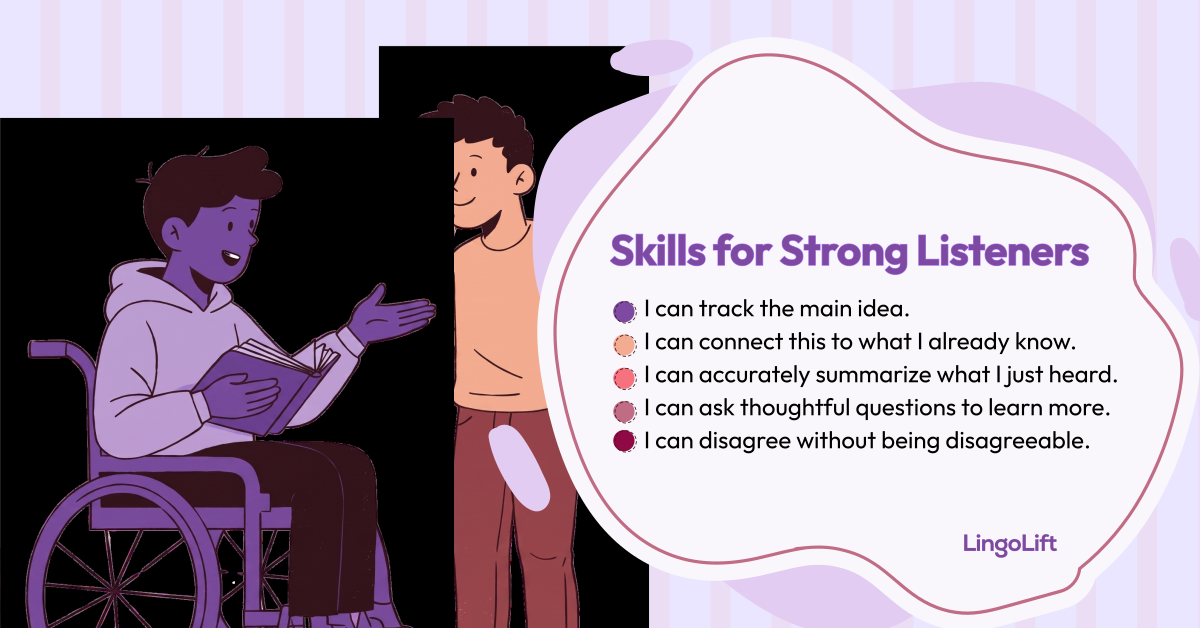
Strategic listeners actively connect what they hear to what they already know. They summarize, identify the main idea, make inferences, and compare new information with what they knew before. During a read-aloud, a teacher might stop to ask: Why did the main character make that decision? Do you know another story like this one? Can you describe it in one sentence? Each question checks that students are making sense of the story, not just hearing it.
Critical listening
Critical listening is evaluative. The listener weighs new information against what they already know to make a judgement or decide what to ask next. Students do this in class discussions, group projects, and debates, where they have to respond to what was said rather than wait for their turn. It’s also the kind of listening behind disciplinary literacy: How does the historian know that? What would change the scientist’s mind?
The 8 key listening comprehension skills
When teachers write listening comprehension questions, they’re usually aiming at eight skills. These line up with the Common Core speaking and listening standards and with the evidence statements behind Smarter Balanced listening items. Here’s each one with a sample question you could ask after a short story.
| Skill | What it asks students to do | Sample question |
|---|---|---|
| Literal meaning | Recall facts and details stated outright | “What did the researchers find in the cave?” |
| Vocabulary in context | Work out a word’s meaning from how it’s used | “What does tenuous mean the way she uses it?” |
| Inference | Go beyond what the speaker says directly | “Why do you think the reporter asked that question twice?” |
| Main idea | Identify the central idea or gist | “What is this story mostly about?” |
| Purpose | Decide why the speaker is speaking | “Is he trying to inform us or persuade us?” |
| Conclusions | Put details together into a judgment | “Based on what you heard, will the town rebuild the bridge?” |
| Reasoning | Analyze how a claim is built | “What reasons does she give for her claim?” |
| Evidence | Find details that support (or don’t support) a claim | “Which detail best backs up his argument?” |
Literal meaning, vocabulary, and main idea check that students followed what they heard. Inference, purpose, conclusions, reasoning, and evidence ask them to think about it. Most listening lessons need a mix of both.
Why listening is hard to teach, and why it’s worth it
Listening is one of the skills employers value most. In GMAC’s 2024 survey of about 1,000 employers, global employers rank “Communication” as their top overall need, and explicitly highlight Active Listening as the anchor of that skill set.
But knowing students need to listen better and knowing how to teach it are two different things.
For years, teachers had few specific strategies to draw on. A teacher might run a listening exercise one day, with little chance to reinforce it later. At higher grades, listening also tends to get treated as a behavior (“pay attention!”) rather than a skill, and teachers are rightly told not to grade behavior. The way around this is to treat listening comprehension the way you would treat reading comprehension. Set a specific listening goal for the lesson, so it becomes something you can teach and measure against a standard.
State tests have pushed in the same direction. Many states now include listening on their end-of-year assessments, so more schools are looking for regular, structured ways to practice it.


Build literacy with every story in LingoLift.
Even when teachers want to build active listening stamina, curating high-quality, level-appropriate audio or video content that captures a student’s attention — especially early in the morning when the room is barely awake — is an immense time sink.
LingoLift solves this. With engaging, real-world stories necessary to capture a classroom’s attention, you can build that listening muscle.
Why listening comprehension matters for reading
The Simple View of Reading (Gough & Tunmer, 1986) says reading comprehension depends on two things: decoding and language comprehension. Researchers measured that second piece by having students listen. Once a student decodes fluently, their reading comprehension tends to track their listening comprehension closely.
Two more findings make listening worth class time in every subject:
- Students understand more by ear for years. Listening comprehension stays ahead of reading comprehension until about grades 6–8 (Sticht & James in Handbook of Reading Research, 1984).
- Many struggling readers are really struggling listeners. Some students decode well but still don’t understand what they read. For many of them, the gap is in language comprehension, which listening builds directly (Hogan, Adlof & Alonzo, 2014).
That’s the idea behind our approach: listening is the key that opens the door to reading, writing, and speaking. For how this plays out in science, history, and math, see Disciplinary Literacy Starts With Listening.
How to teach listening comprehension
Teach it the way you’d teach reading comprehension: build background, give a purpose, support during, and do something with it after.
- Before you press play (3–5 minutes)
Preview 3–5 key words with pictures. Post one or two questions so students know what to listen for. - First listen: the gist
“What’s this mostly about?” Students tell a partner in one sentence. - Second listen: details
Pause after key sentences for a cloze sentence, a quick note, or a partner check. - Third listen: language
Replay a sentence with a target word or a structure from your subject, like how a scientist states a cause. Have students borrow it. - After listening (5–10 minutes)
Talk, then write: one claim with one detail from what they heard.
A read-along transcript helps at first. Fade it as students get stronger, so they rely on their ears.
Strong listeners also manage their own listening. Teach four quick moves: predict (“What will we hear?”), check (“Was I right?”), fix (“Where did I lose track? Replay it.”), and reflect (“What helped me follow?”).
Listening comprehension activities that work in any subject
1
Turn and talk
Ask a question, give 30 seconds, then call on pairs
2
Partner restate
One student answers; their partner reports what they said
3
Find the gist
Pairs agree on one sentence: who it’s about, and the most important thing it says
4
Debate the opinion question
Short stories with a real point of view make great debate starters
5
Listen, then read
Play a story first, then hand out the related textbook section or primary source. Students go in with the vocabulary and a question already in hand
Listening comprehension for English learners
Everything above works for multilingual learners, with a few additions. Let students use their home language to brainstorm or take notes. Point out cognates. Slow the audio down and replay it, which lowers the load without watering down the content. Offer sentence frames, and give low-stakes ways to speak before whole-class answers.
Most of all, match the language to their level and the ideas to their age. A 15-year-old newcomer deserves a real story about science, not a picture book. More in our guide to English learners.
Assessing listening comprehension
Many states now assess listening on their end-of-year tests, including the CAASPP in California, plus English language proficiency tests like ELPAC, TELPAS, and WIDA ACCESS. A quick listening check can be as simple as three questions after a story: one literal, one inference, one main idea.

Practice listening comprehension with LingoLift
We’ve been building listening lessons since 2013, as Listenwise. In 2026 we became LingoLift, because teachers kept telling us what we’d seen too: listening opens the door to reading, writing, and speaking.
- 3,000+ short lessons across ELA, social studies, science, math, ESL, and SEL, for grades 2–12
- Real audio and video from public radio and trusted media brands, never synthetic voices
- Read-along transcripts on every lesson
- Comprehension and language activities that practice all four skills, tagged to grade and English proficiency level
- Instructions in students’ home languages
- Free for teachers
Frequently Asked
Questions you might have
What is listening comprehension in simple terms?
It’s understanding what you hear: following the ideas in spoken language, connecting them to what you know, and being able to explain or respond to them.
What are the types of listening?
Appreciative, discriminative, informational, strategic, and critical. All but appreciative are forms of active listening.
What are listening comprehension skills?
The core eight are literal meaning, vocabulary in context, inference, main idea, purpose, drawing conclusions, analyzing reasoning, and finding evidence.
How can students improve listening comprehension?
Give them a purpose before they listen, play short audio more than once with a different focus each time, and have them talk or write about it afterward. Build the habit with a short, regular routine rather than occasional long sessions.
How is listening comprehension tied to reading?
Once students can decode, reading comprehension closely follows listening comprehension. Listening builds the vocabulary, background knowledge, and sense of sentence structure that reading depends on.
Is listening practice only for English learners?
No. English learners and students still working on decoding gain access to grade-level ideas, and strong readers gain vocabulary, knowledge, and better discussions.
Every classroom is a literacy classroom.
Make yours one.
Short, real stories your students will actually want to finish.
Join LingoLift Insiders
For early looks, a say in what we build, and — naturally — swag!
It’s just a no-brainer. The curation is excellent, and the resources provided are amazing.
★★★★★