
Free Resources for Teachers
Every classroom is a literacy classroom
LingoLift is a cross-curricular literacy supplement that supports core instruction and intervention with thousands of classroom-ready lessons built from real-world podcast and video stories.
Here you will find our teacher guides, printables, unit plans, and strategies for literacy – completely free!
Talk to our team
Everything we’re building is shaped by real feedback from the teachers and district leaders using LingoLift today. We are a team of former and current classroom educators who care deeply about literacy, and we are always ready to chat about your goals.
Stuck on a unit plan and need fresh ideas? Figuring out how to use LingoLift without a 1:1 device ratio? Or just looking to brainstorm how to weave real-world media into your next science or history block? We’d love to hear from you.
Let’s find what you need
(New around here? Start with the resources under “Get Started.”)

2 Resources

Coming Soon
4 Resources
2 Resources
4 Resources

Coming Soon
1 Resource
1 Resource
Tips from the LingoLift team
“If you’d like students to follow along with the text, you can project LingoLift’s read-along transcript on your board. That way the whole class gets the sentence highlighting without any logins or extra screen time!”

Jasmine, Customer Success Manager
Get Started
Quick-start guides, catalogs, and onboarding tools to help you launch your first LingoLift lesson today.
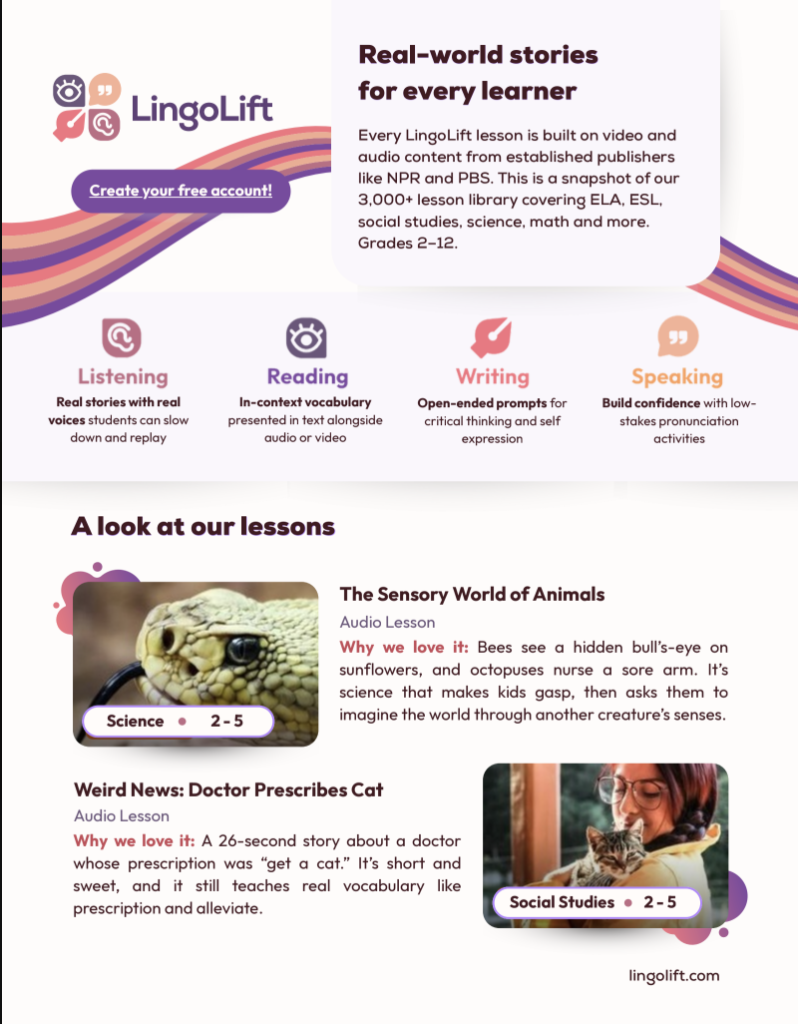
LingoLift Content Catalog Sample
All Grades · PDF
Get a quick look at some of our favorite lessons in the LingoLift library, and why we love them.
Latest Features on LingoLift
Product Features Guide · PDF
See what’s new on the platform! Updated for November / December 2026.
Teach Any Lesson
We’re currently building out our universal graphic organizers and instructional routines you can pair with any story in our library. Check back soon!
Unit Plans
Ready-to-teach lesson sequences with built-in activities, checkpoints, and scaffolds.
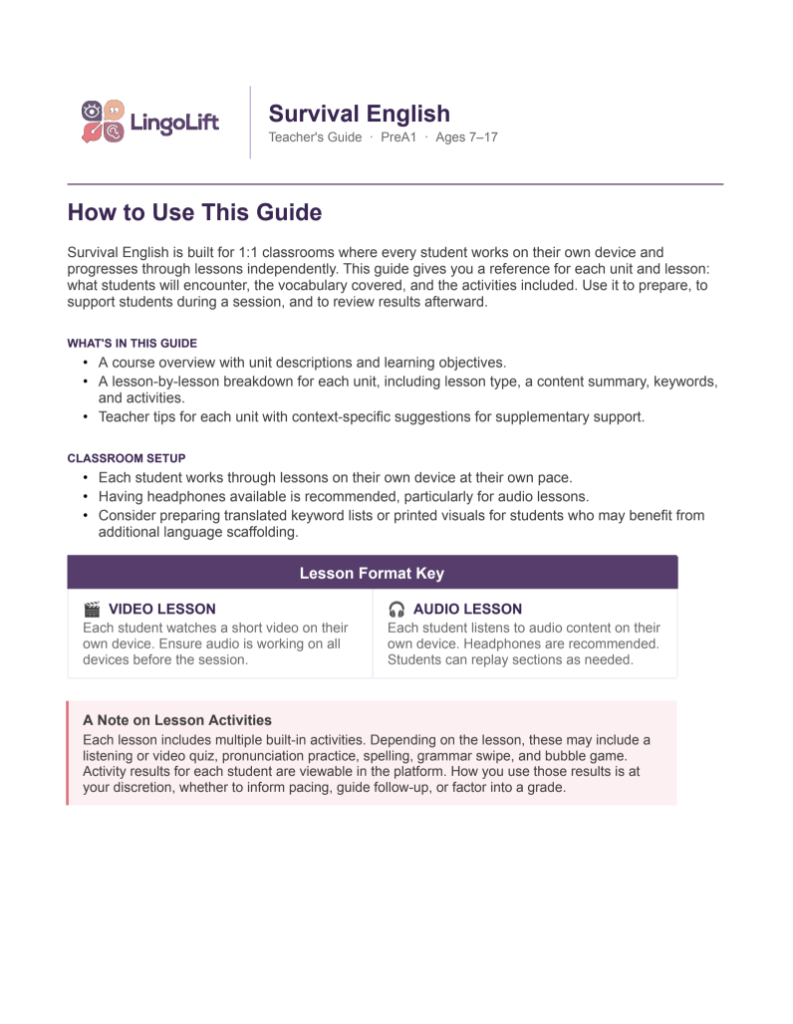
Survival English
Grades 2–12 · Beginner English learners · Course guide
Survival English is a Pre-A1 English course designed for newcomers to English between the ages of 7 and 17 who are living in the United States. The course builds foundational language skills for everyday personal interactions: greeting people, introducing yourself, talking about family and location, spelling your name, counting, and sharing basic personal information.
Organized into 7 units, each focused on a specific real-world context. In a 1:1 classroom,
students work through audio and video lessons independently on their own devices, with the teacher circulating to provide support, clarification, and supplementary practice as needed.
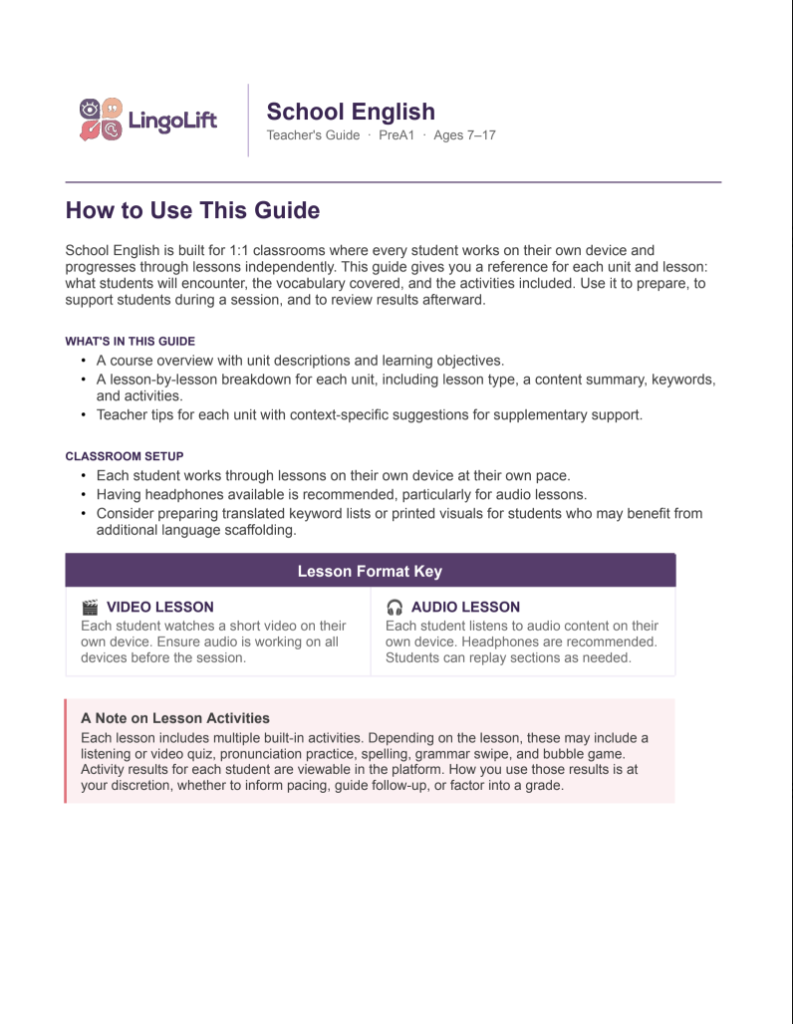
School English
Grades 2–12 · Beginner English learners · Course guide
A Pre-A1 English course designed for newcomers to English, the course builds practical language skills for navigating a US school environment: understanding the school building and classroom, asking for help, telling time and identifying days and dates, and sharing contact information.
Organized into 5 units, the course is focused on specific real-world contexts and designed for a 1:1 classroom where students work through audio and video lessons independently on their own devices.
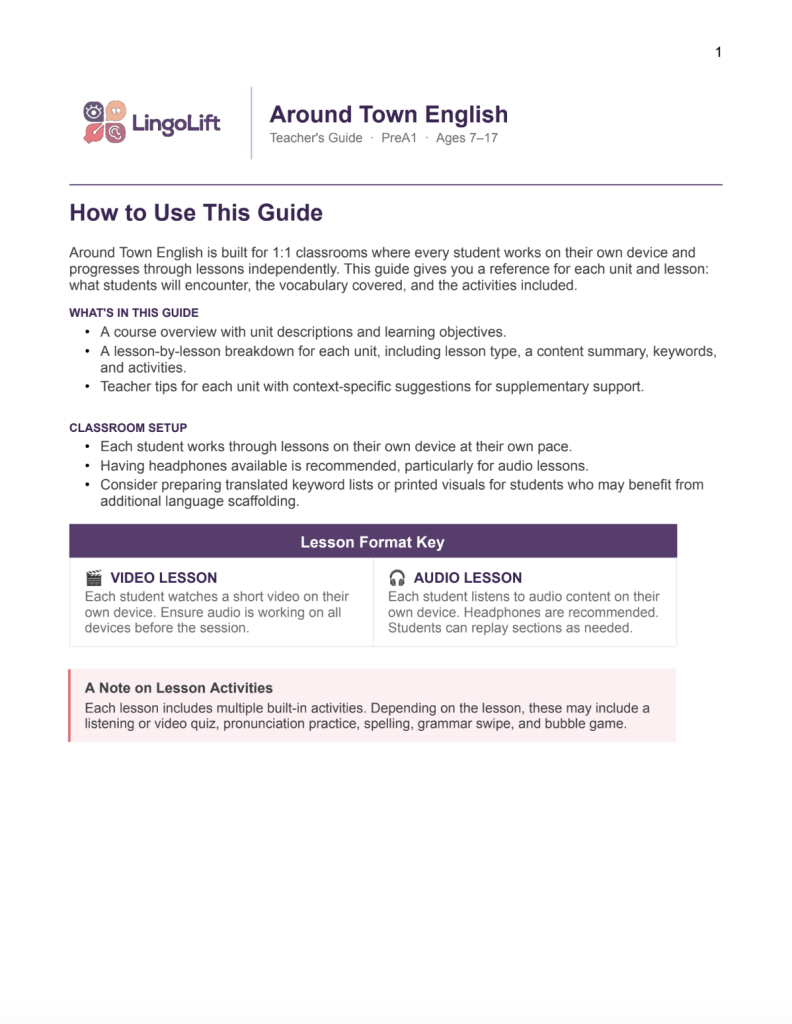
Around Town English
Grades 2–12 · Beginner English learners · Course guide
A Pre-A1 English course designed for newcomers to use English immediately in their daily lives outside of school: on the phone, on the street, in stores, and in public spaces.
Organized into 6 units for a 1:1 classroom, students work through audio and video lessons independently on their own devices.
Course will equip students to communicate in basic real-world scenarios with growing confidence, and will build listening comprehension for common public interactions.
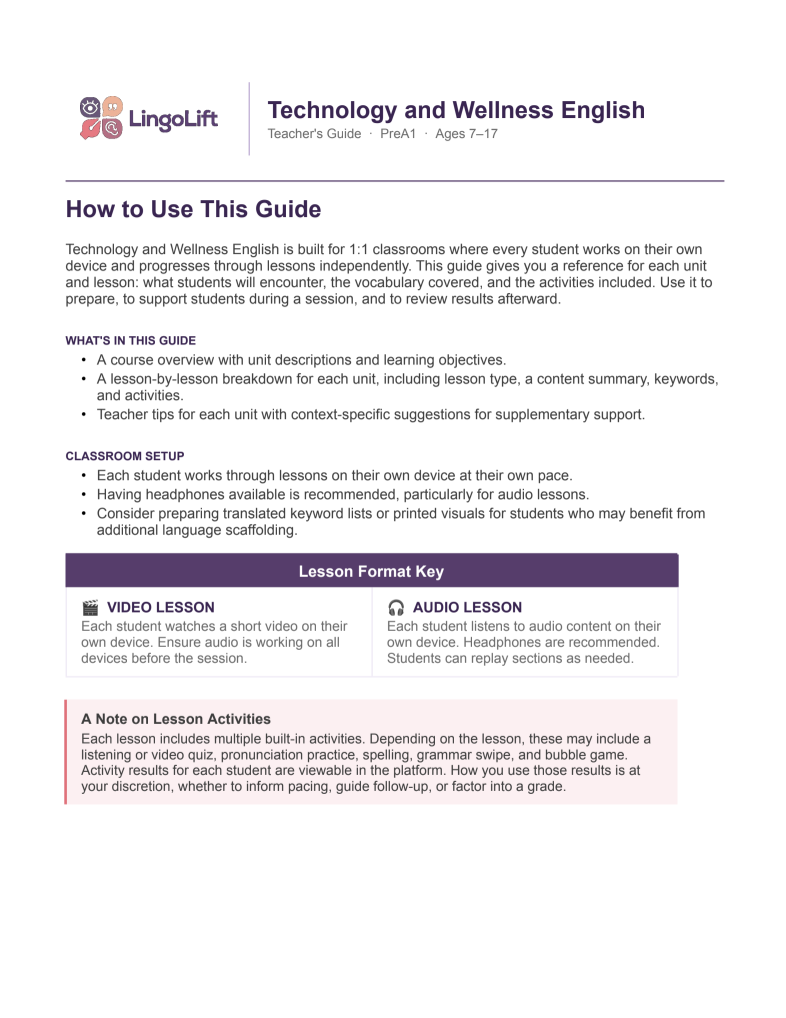
Technology and Wellness English
Grades 2–12 · Beginner English learners · Course guide
This is a Pre-A1 English course designed for newcomers to English between the ages of 7 and 17 who are living in the United States. The course builds language skills across two essential areas of daily life: using technology (computers, passwords, social media)
and talking about health and wellness (body parts, illness, emotions, and weather).
Organized into 5 units, each focused on a specific real-world context, for a 1:1 classroom where students work through audio and video lessons independently on their own devices, with the teacher circulating to provide support, clarification, and supplementary practice as needed.
English Learners
Specialized newcomer courses and strategies to build academic language and confidence.
How to Teach Newcomer English Learners: A Practical Guide for Grades 2–12
All Grades · Article
Teaching newcomer English learners effectively requires age-appropriate, scaffolded content—not lower-level materials. This article covers why is newcomer instruction so different, how to lower the affective filter, how to set content and language objectives for newcomers, and more.
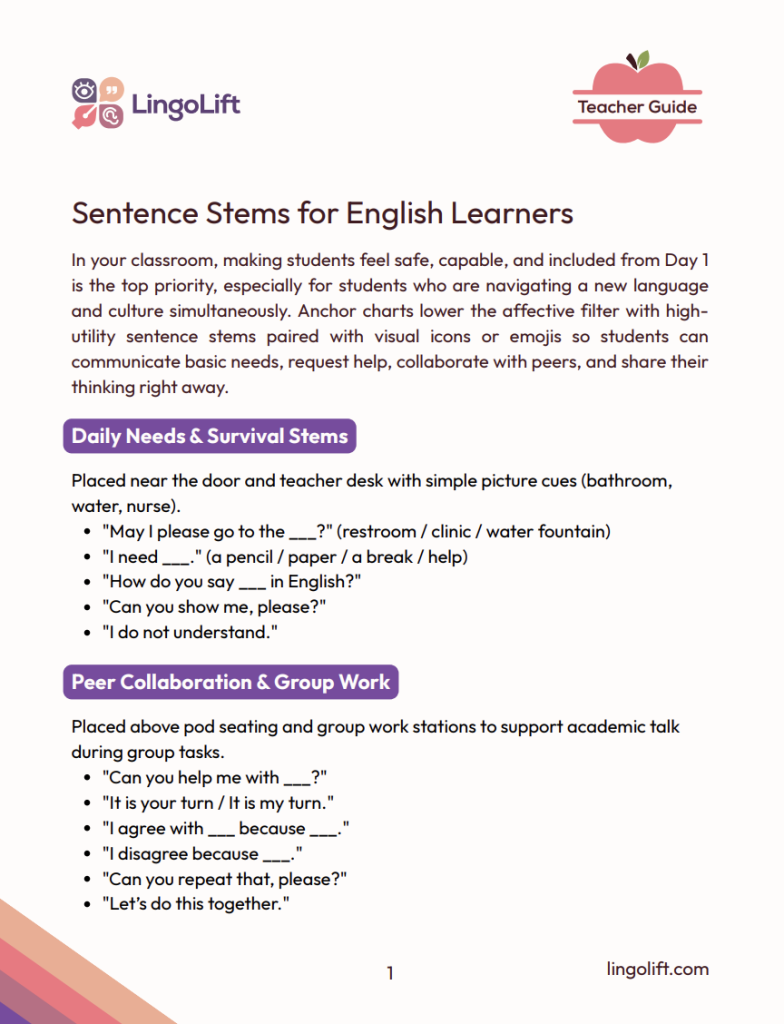
Sentence Stems for English Learners
All Grades · PDF
Teaching newcomer English learners effectively requires age-appropriate, scaffolded content—not lower-level materials. This article covers why is newcomer instruction so different, how to lower the affective filter, how to set content and language objectives for newcomers, and more.
Listening
Research-backed frameworks to help students turn passive hearing into active comprehension.
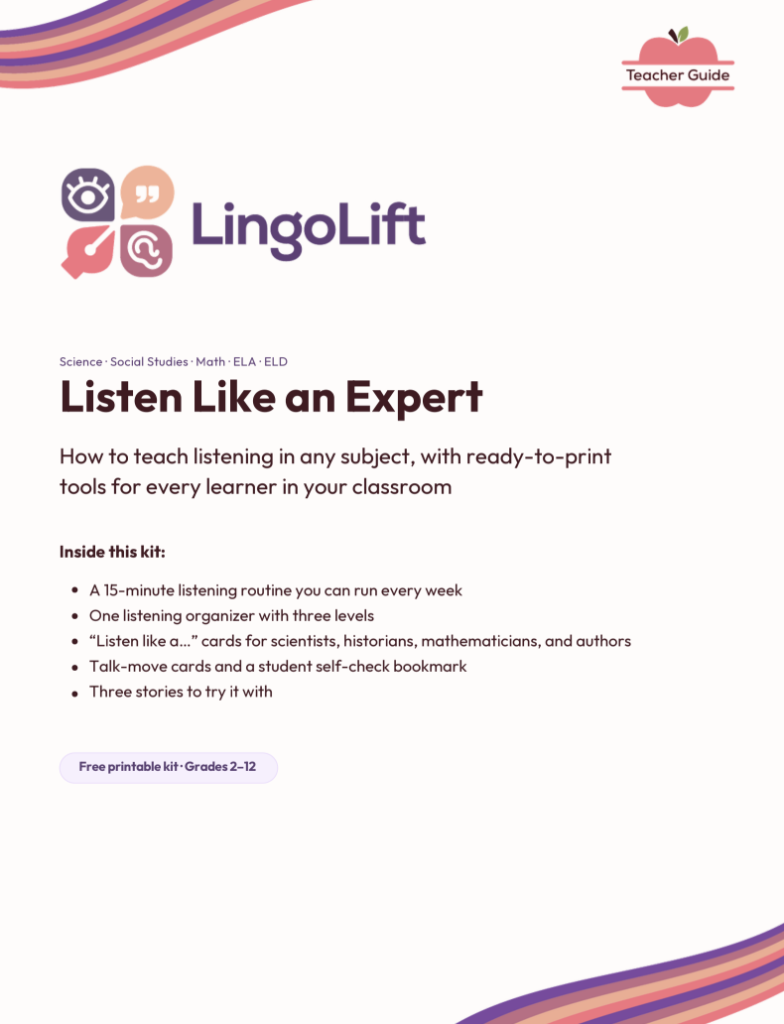
Listen Like an Expert
Grades 3-5 · Grades 6-8 · Grades 9-12 · PDF
What does it mean to listen like a scientist, a mathematician, or an author? This kit introduces a 15 minute listening routine you can run every week, and includes a listening organizer (at 3 levels!), “Listen like a…” cards, talk-move cards, a student self-check bookmark, and three LingoLift stories you can try it with.
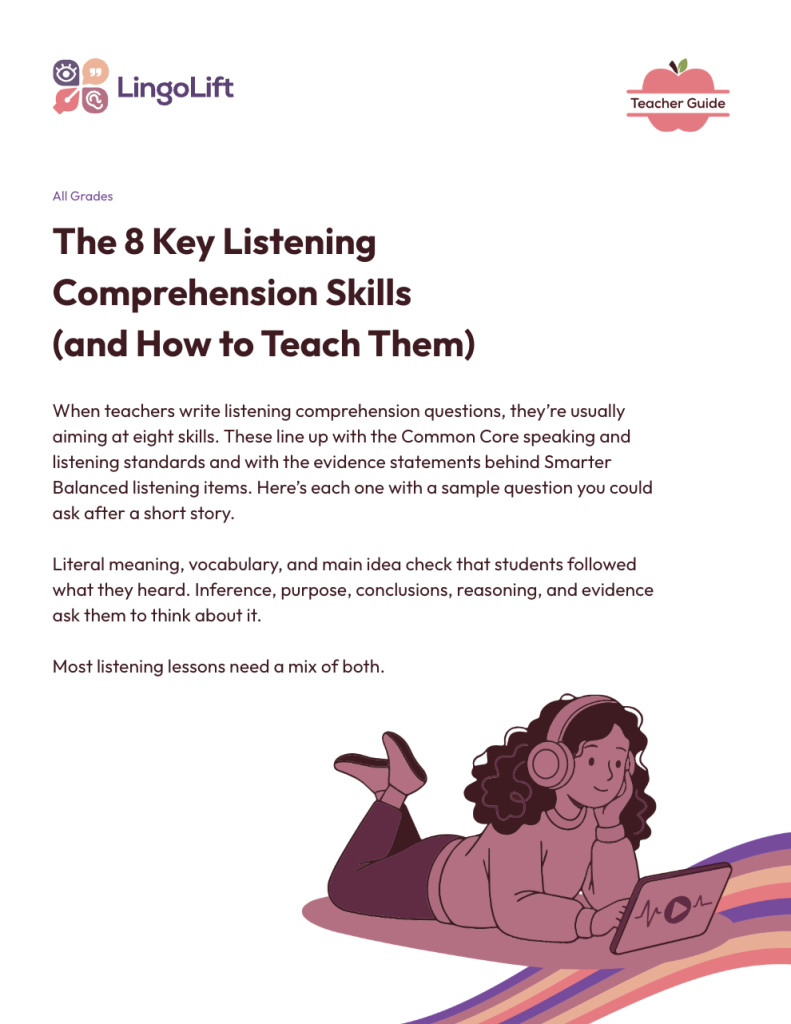
The 8 Key Listening Comprehension Skills (and How to Teach Them)
All Grades
A reference sheet for educators on the 8 key listening comprehension skills, what they mean, and how to teach them.
What is Listening Comprehension?
All Grades
Did you know that reading comprehension tends to follow listening comprehension? That makes listening one of the most practical ways to bring the whole class into grade-level material. In this article, we cover the 5 types of listening, the 8 skills that make up listening comprehension, why listening has been so hard to teach, and strategies that work in any subject.
3 Ways to Turn Short Podcasts Into Literacy Lessons
All Grades
Your class is glittering in genuine discussion, and the text that sparked it was less than ninety seconds long. Not all audio is classroom-ready. But a podcast earns a place in a lesson when it’s short enough to replay, surprising enough that students want to know how it ends, and is led by real, actual reporting from actual publishers, not synthetic narration.
Learn how short, high-interest audio gives every student a way into a text before the friction of decoding.
Reading
We are currently building out our dedicated reading resources. Check back soon for guides on pairing audio and video with primary texts.
Writing
Printable kits and organizers to help students synthesize, argue, and write about what they’ve heard.
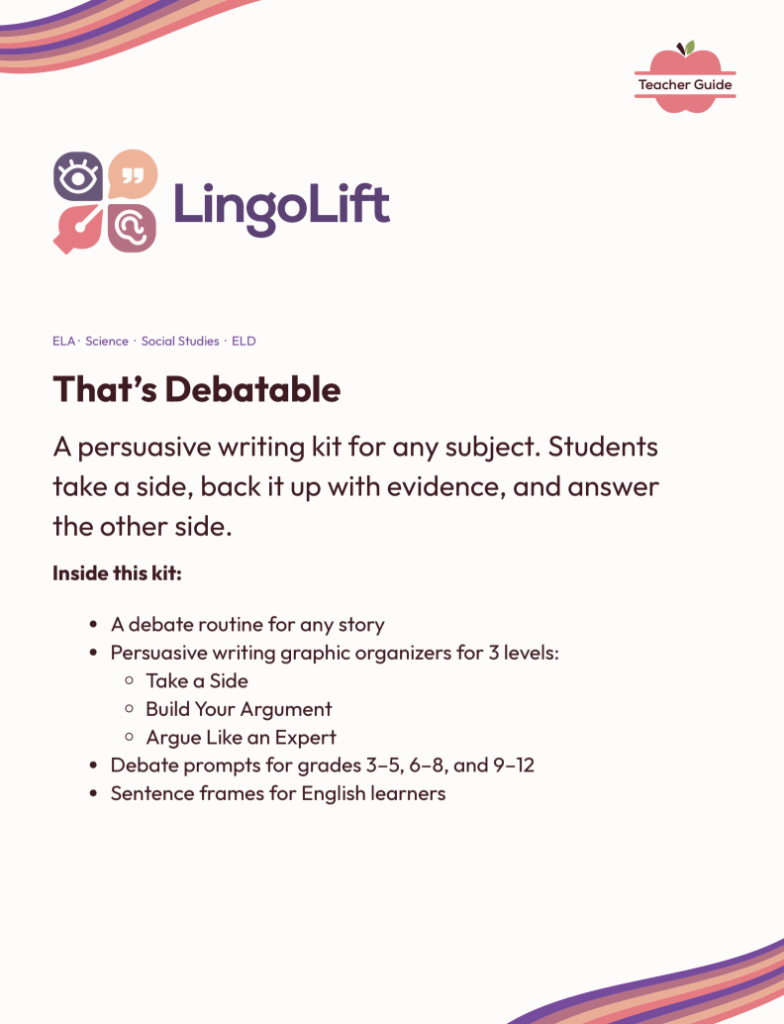
“That’s Debatable” Persuasive Writing Kit
All Grades
A persuasive writing kit for any subject. Students take a side, back it up with evidence, and answer the other side. This complete kit includes: a debate routine for any story, persuasive writing graphic organizers for 3 levels, debate prompts for grades 3–5, 6–8, and 9–12, and sentence frames for English learners.
Speaking
Structured discussion routines to get students debating, defending claims, and sharing ideas aloud.
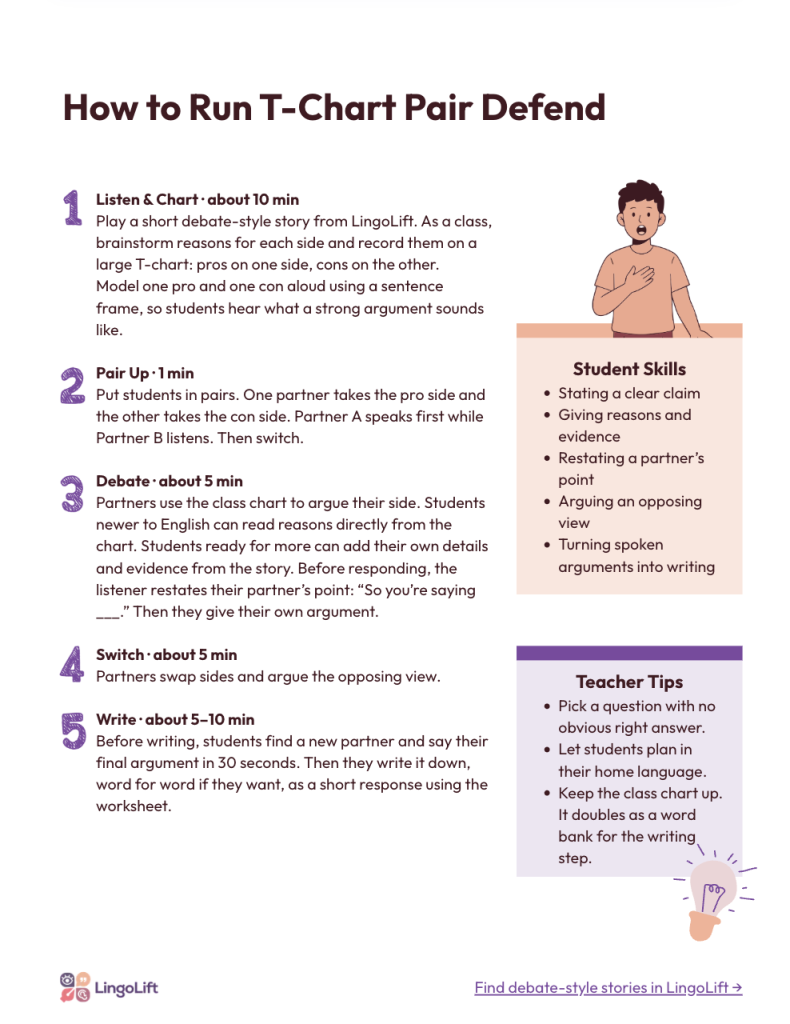
“T-Chart Pair Defend” Speaking Practice
All Grades
Speaking is one of the most underused literacy skills. This kit helps your students state a claim, back it up with evidence, and articulate an opposing point of view.
Adapted from Seven Steps to a Language-Rich Interactive Classroom, use this to give every student structured time to rehearse their thinking. By the time they pick up a pencil or sit at the keyboard, they’ve already built their argument!