
Summary:
- LingoLift provides age-appropriate current events and news stories for grades 2-12, covering elementary school, middle school, and high school
- Stories are divided into easily searchable categories: In the News, Did You Know?, Weird News, and That’s Debatable.
- All lessons include built-in, interactive listening, speaking, reading, and writing practice, which are ideal for English learners and striving readers.
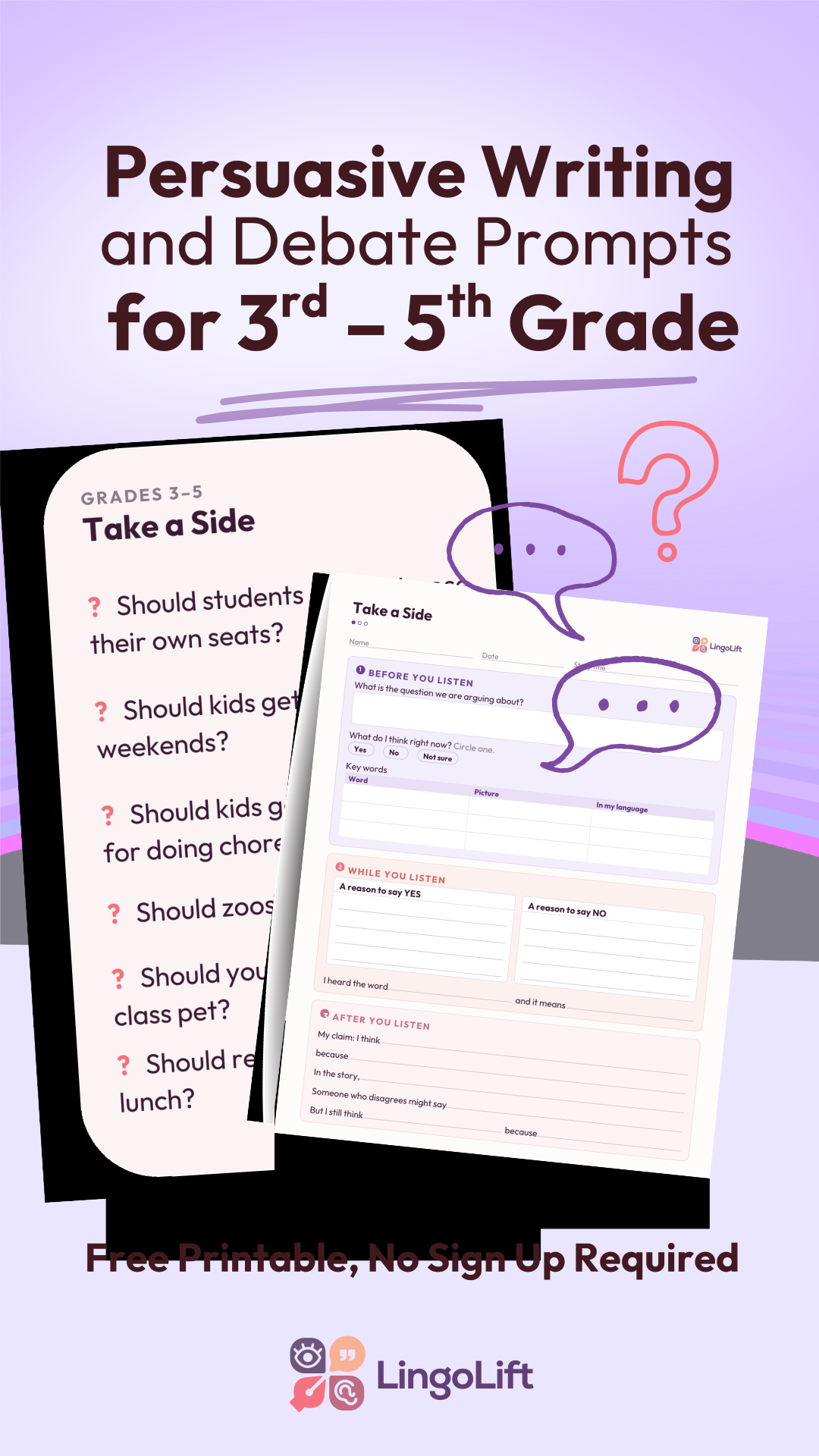
- Free download: We made a persuasive writing graphic organizer you can pair with any LingoLift lesson, or your own content.
Your students aren’t learning about the world only from lesson plans. They’re absorbing it all day: overhearing their parents’ kitchen-table conversations, catching 15-second radio snippets, and, mostly, scrolling through social media ragebait and heated comment sections. News articles for students who are still learning to think critically are hard to find, yet they still come to class with opinions on everything. They just rarely have the context or the skills to discuss those opinions productively.
The classroom is the ideal place for structured, healthy discussions about the real world. What you don’t have time for is to vet articles, verify sources, do a topic sensitivity check, and build language exercises from scratch. Every single week.
LingoLift’s current topics take that work off your plate. LingoLift is an educational platform that provides short stories and lessons for students grades 2-12, told through high quality audio and video from public radio and real-world media. Listening, speaking, reading, and writing practice are built in with interactive activities in every lesson. And instead of one giant, cluttered bucket, they’re sorted into categories so you can find exactly what kind of story you need – without losing your prep period!
Why use four categories for news for students?
On our old platform, “current events” was a bit cluttered with everything from timely events to evergreen stories. Now there’s a home for both, alongside a home for stories built for argument and ones built to surprise you.
How to find news stories on LingoLift
While we work on a separate filter, the category names are easily searchable. Just type in “in the news,” “did you know,” “weird news,” or “that’s debatable” directly into the LingoLift lesson search bar.
In the News: Timely current events for the classroom
These are stories about something that just happened, or topics that get sustained coverage. An older story makes the cut if people are still actively talking about it, like new research or an emerging technology. A few to check out:
- Fact Check: Is this Japan Costco earthquake video from 2016 or 2026?
“This video of a Costco in Japan has gone viral after a major earthquake hit the country’s southern Kyushu island. Here’s how we verified the video.” - Ancient Roman Faces Brought Back to Life in Budapest Exhibition
“Using archaeology, anthropology and DNA analysis, experts reconstructed Roman-era faces and paired them with imagined life stories inspired by historical evidence.” - El Nino and Why We Can’t Predict the Weather
“What is El Nino? Why can’t we predict the weather? Just a few slight changes in global climate patterns can drastically shift the weather. Thanks to chaos theory, even our smartest meteorologists can’t predict weather correctly.”
Try it! Open the week with an In the News story and ask, “What did you already know about this before you heard it?”
Did You Know?: Classroom conversation starters and fun facts
If you used Weird News on Listenwise, this is its new home. Did You Know? Stories are surprising, human, or just plain fun. Expect fun facts, human-interest stories, and SEL topics that get students talking. Weird is still welcome, it’s just no longer required.
- How Teenagers’ Lack of Sleep is Taking a Toll on Their Mental Health
“Research has found that teenagers should be getting eight to ten hours of sleep every night. But many are sleeping far less than that and nearly one in four also suffer from insomnia. William Brangham reports on why it’s so hard for so many teens to sleep, and why it’s taking a toll on their mental health. It’s part of our ongoing series, Early Warnings: America’s Youth Mental Health Crisis.” - What Did Boys Learn In Ancient Greek Schools?
“In ancient Greece, education went beyond reading, writing, and arithmetic.” - Who Helps the Homeless? It’s A 9-Year-Old Superhero!
“This 9-year old has a passion to help the homeless. Equipped with his superhero attire and a lot of help from his parents, he is changing the lives of thousands of homeless individuals.”
(Looking for your favorite Weird News stories from Listenwise? Don’t worry! They’re still there. Just type “weird news” into the lesson search bar.)
Try it! These work well as classroom conversation starters. Play the story, give students 30 seconds to think, then turn and talk with a partner. For English learners, post a few sentence stems (“I was surprised that ___”, or “I think __ because __”); our sentence stems for English learners are a good place to start.
That’s Debatable: Persuasive writing and debate prompts
These stories and videos give students real arguments on more than one side. The debate question is built into each lesson, so the persuasive writing prompt or debate prompt is already there when you introduce it.
- Educators Worry About Students Using Artificial Intelligence to Cheat
“Earlier this month, New York City public schools blocked access to the popular artificial intelligence tool ChatGPT. Educators are concerned that students could use this technology to write papers – the tool wasn’t even a month old when a college professor in South Carolina caught a student using it to write an essay in philosophy class. Darren Hick of Furman University joins John Yang to discuss.” - Doctors Back Social Media Ban for Children and Youth
“Some Manitoba doctors favour a ban on AI chatbots and social media for children and youth, a new survey suggests. Physicians ranked social media among the top three risks to kids’ health and well-being.” - Warning from Charities as Popularity of Exotic Pets Soars
“As we all know, a dog is for life, not just for Christmas. But the same is true for more exotic pets, which can find themselves unwanted and abandoned after the festive period.”
Try it! Start with the writing prompts in the lesson, then invite students to pick a side and debate.

Setting the stage for civil discourse
Before you introduce a current topics lesson, it helps to establish classroom norms. The abundance of heated language in the public sphere can make current events intimidating to tackle, but you don’t have to build those guardrails from scratch. Here are a couple of our favorite resources for fostering healthy debates:
- Facing History and Ourselves: Excellent lesson plans on Fostering Civil Discourse.
- Edutopia: Quick, actionable tips for Teaching Students to Argue Respectfully.
Once your students understand the ground rules, you can plug LingoLift into a reliable weekly framework.
How to make good stories a classroom routine
You don’t need to derail your syllabus to talk about the real world. We recommend a simple, 15-minute weekly routine to build critical thinking and active listening skills:
- Listen & Process (5 mins): Play the short audio or video. Have students follow along with the read-along transcripts.
- Turn & Restate (5 mins): Pair students who disagree on the topic. Before they can share their own opinion, they must accurately restate their partner’s argument.
- Quick Write (5 mins): Students spend five minutes writing a single paragraph answering the debate question, citing one piece of evidence from the audio.
Why this works so well for ESL students: Print asks students to decode first and think second. Short podcasts and videos flip that order. Because everyone hears the story at the same pace and can follow the home-language instructions and read-along transcripts, your English learners and striving readers get to the critical thinking faster. Real voices and authentic stories build the intrinsic engagement required to tackle complex language.
We recommend a simple routine for classrooms that takes less than 15 minutes each week. Depending on your students level, you can strage instructions mean your English learners and striving readers can work on the same story and the same question as everyone else.
Want more ways to run a discussion? Try these three frames.
Why short podcasts and videos work best for teaching news to ESL students
Print asks students to decode first and think second. Short podcasts and video flip that order: everyone hears the story at the same pace, follows along in the transcript, and gets to the thinking faster. For newcomers, real voices and real stories are also more interesting than a leveled passage written to practice a grammar point, and interest is half the battle for ESL students.
Free persuasive writing graphic organizer
We made a free printable to go with That’s Debatable: a persuasive writing graphic organizer, with debate prompts for grades 3-5, 6-8, and 9-12, and sentence frames for English learners. It works with any of the lessons above, or with any story you’re already teaching!
Free Download
Ready to stretch that 15-minute routine into a full writing unit?
We built a free, printable Persuasive Writing Graphic Organizer specifically designed to pair with our That’s Debatable lessons. It takes the friction out of the drafting process and includes:
- Structured debate prompts broken down for grades 3-5, 6-8, and 9-12.
- Clear sections for claims, reasons, evidence, and counterarguments.
- Built-in sentence frames to scaffold the work for English learners.
It seamlessly pairs with any LingoLift lesson, or any text you are already teaching.
Get Started Today
Teachers start free.
3,000+ lessons designed for listening, reading, writing, and speaking. Every lesson is built on a podcast or video from our authentic media partners, from NPR to Complexly.
What stories will you share?
Leave a Reply