

Quick Summary: Teaching newcomer English learners effectively requires age-appropriate, scaffolded content—not lower-level materials. Focus on survival language in the first two weeks, pair spoken audio with read-along transcripts, and use structured sentence stems to lower the risk of classroom speaking.
In this article:
- Who newcomers are, and what to call them
- What should you do in the first two weeks with a newcomer?
- Engaging families across language barriers
- Why is newcomer instruction so different?
- Lowering the affective filter — and why safety precedes learning
- How do you set content and language objectives for newcomers?
- More tips for video and audio with multilinguals
- How do you get newcomer English learners to speak in class?
- After the lesson, how to check understanding across four domains
- How do you grade a newcomer?
- What to look for in newcomer-friendly materials
- FAQ
It’s a crisp October morning, and a new student arrives in your class. The office sends a folder with a birth date, an address, and a note that the family speaks Tigrinya. Nobody can tell you what grade she finished, or whether she finished one. Class starts in four minutes.
This guide is for that morning, and for the months after it.
Who newcomers are, and what to call them
“Newcomer” usually means a student who arrived in the country within the last one to three years. The exact definition varies by district, and yours may attach specific services to it. The word covers an enormous range of learners. One newcomer might’ve finished ninth grade in Caracas at the top of her class and is doing algebra in her head while she waits for the English to arrive. Another spent four years in a camp with no school at all. A third has been in three countries in two years and has a different gap in each subject.
These kids will sit in the same room and need different things from you. All of them already know a great deal, but can’t yet show you most of it in English.
The terminology, briefly, for this student population
| Term | Definition & Context | Preferred Usage |
|---|---|---|
| Multilingual Learner (MLL) | Focuses on student assets; widely used in WIDA-aligned states. | Preferred throughout this guide. |
| Multilingual Learner (MLL) | Federal legal term used for state compliance, funding, and reclassification. | Used where legally or structurally relevant. |
| Emergent Bilingual | Commonly used in state-specific frameworks (e.g., Texas). | Regional alternative. |
| Home Language | Replaces “native language” to reflect lived student experience. | Preferred over native language. |
This guide says multilingual learner from here on, and switches to English learner where the legal, curricular, or funding context requires it.
Students with interrupted formal education
Some newcomers are also SLIFE, meaning students with limited or interrupted formal education. While exact definitions vary, the usual marker is two or more years of interrupted schooling, or literacy in the home language well below what their age would suggest.
It’s easy to see why SLIFE students overlap with English learners. But SLIFE is a unique instructional problem: a student who has never held a pencil for six hours a day is learning how school works at the same time as learning English. The routines, the print conventions, the social dynamics, the expectation to take notes are as new as English vocabulary. If you suspect a student is also SLIFE, ask the registrar, ask the family liaison, or ask the family through an interpreter.
What should you do in the first two weeks with a newcomer?
In this stretch, formal learning objectives and content are put on hold. The first two weeks are about urgent, survival English and easing the transition to school.
- Teach survival language on day one.
Bathroom. Water. Lunch. Bus. Help. I don’t understand. Where is my class? Teach these with images, and practice them. - Get their name right.
Ask the student to say it, say it back, ask again, write it phonetically for yourself. Practice until you have it. This will help the student determine whether this room is safe. - Expect a silent period.
Many newcomers go days and sometimes months where they take in language without producing it. This is normal! Do not force output. Keep including them in everything, and accept pointing and nodding or drawing as participation. - Assign a buddy!
Someone who shares the home language is ideal, but any kind, reliable classmate is better than nobody. - Post a visual daily schedule.
Use icons alongside times. Visual cues make a huge difference. - Find out what school has looked like for them.
This information is valuable to you early on; you don’t want to find out four months into the year!
Do not seat a newcomer at the back with a picture dictionary and a worksheet. This is a common thing that happens to newcomers in mainstream classrooms. It can quickly lock them out of the social elements of learning.
Engaging families across language barriers
The family of your newcomer wants them to succeed just as much as you do, but the U.S. school system might be entirely foreign to them — and the language barrier can make reaching out feel intimidating for everyone. A strong start with caregivers builds trust that pays off all year. Here are the ground rules for making that connection:
- Never use the student as the interpreter.
It is highly common, and highly inappropriate, to ask a bilingual student to translate for their parents. It creates an unfair power dynamic, places a heavy adult burden on a child, and often results in filtered information (especially if you are discussing grades or behavior). - Use your district’s translation infrastructure.
Ask your front office or EL department how to access professional interpreters. Many districts subscribe to on-demand phone services or provide access to two-way translated messaging apps. Find out what tools you have before you need to make an urgent call. - Call for the good things first.
If the first time a family hears from the school is because their child is failing or acting out, fear and defensiveness will set in. Make the first communication a positive one. A simple translated message saying, “Your child had a great first week and I am so happy they are in my class,” establishes you as a safe partner. - Understand the cultural context of “school.”
In the U.S., parents are expected to be highly involved: attending conferences, volunteering, and emailing teachers. In many other countries, education is viewed as the exclusive domain of the school. Parents show their respect by not interfering and deferring entirely to the teacher’s authority. If a family misses back-to-school night, do not assume they don’t care.
Why is newcomer instruction so different?
There are two very common pitfalls to teaching newcomers. The first is giving a fifteen-year-old material built for six-year-olds because the English level matches. The content is about farm animals and colors. The student feels othered, and their engagement drops before their English language skill has a chance to arrive.
The second pitfall is handing over the same dense text everyone else got, with a bilingual glossary stapled to it. The student looks at four hundred words of academic English, cannot find a foothold, and freezes.
The best practice that works sits between them: age-appropriate content, with different ways in.
A fourteen-year-old who is at the earliest stages of English is still fourteen. He has opinions about politics and music and his own life. The content should assume that. What changes is how he gets to it: through audio and video rather than only print, through images before words, through his home language where it helps, through repeated passes at the same short text rather than one pass at a long one, through sentence frames that hold the shape of the answer while he supplies the meaning.
Your multilingual learners are doing two jobs at once, and one is invisible on any assessment you give in English. This exact challenge is why LingoLift’s newcomer library relies on high-interest, age-appropriate media from creators like PBS, TED-Ed, and Complexly. A high school student can learn survival English through engaging, real-world topics without ever feeling talked down to.
Lowering the affective filter — and why safety precedes learning
Many newcomers arrive carrying invisible weight. For some, it’s the trauma of fleeing a conflict zone or navigating the refugee system. For others, it is simply the profound, exhausting disorientation of being dropped into a school where they do not know the language, the social rules, or how to ask for help.
In language acquisition, there is a concept called the affective filter. Think of it as a mental brick wall built by stress, anxiety, or fear. When a student’s affective filter is high, their brain is in survival mode. No new language can get in, and no spoken language can get out. No matter how perfectly scaffolded your lesson plan is, safety must precede learning.
To actively lower that filter in your classroom, embrace predictable routines, prioritize connection, and reframe the “Silent Period.”
Trauma and anxiety thrive in chaos. A highly predictable classroom environment signals safety. Post a visual daily schedule, use consistent warm-up routines, and keep transitions structured so the student always knows what is coming next.
Prioritizing connection means pausing on correction. When a newcomer finally takes the massive risk of speaking, focus entirely on the meaning they are trying to communicate, not the accuracy of their grammar. If they say, “I no have pencil,” handing them a pencil with a smile lowers the filter. Stopping them to say, “I do not have a pencil,” raises it.
Finally, as mentioned earlier, months of silence is a normal stage of language acquisition. It’s also a protective mechanism. A student who refuses to speak is often just waiting until they feel certain they won’t be mocked for their pronunciation, or othered by their attempts to break through. So don’t force them into the spotlight. Let them participate through drawing, pointing, or choral reading until they feel safe enough to use their own voice.
How do you set content and language objectives for newcomers?
Every lesson needs two objectives: one for what students learn about the subject, and one for what they do with language to get there. A good language objective names both a function (what the language does) and a form (the structure it uses). Here are four worked examples.
Example 1: Food and preferences
Content: Students will identify common foods.
Language: Students will describe food preferences using like, prefer, and don’t like, including negative sentences.
Example 2: Classroom activities
Content: Students will name common classroom activities.
Language: Students will describe what someone is doing using the present progressive, as in she is reading the book.
Example 3: The environment
Content: Students will explain ways to protect the environment.
Language: Students will use verbs with the prefixes re- and un- to describe actions, as in reduce, reuse, recycle.
Example 4: The solar system
Content: Students will compare planets by size and distance.
Language: Students will compare using comparatives and superlatives, as in bigger, biggest, closer, closest.
Notice that each language objective could attach to almost any topic. Once you have the form you want, you can find content that carries it. Post both objectives and say them out loud at the start. Return to them at the end and ask students to show you the form, not just the content.
Build background knowledge before the lesson
Just like other students in your classroom, newcomers arrive with prior knowledge about almost every topic you teach. But it’s stored in another language and it will not come out unless you go and get it.
- Start with one image and no text. Show it. Ask what students notice, then what they wonder. Accept anything: a word in the home language, a drawing, pointing, a single English noun. This shows you’re opening the topic – not assessing it!
- Then show the image with the target vocabulary attached. Now the words have something to hold on to.
- Ask about cognates. For Spanish speakers this is enormously productive, and it works for Portuguese, French, Romanian, Italian, and Haitian Creole speakers too. Simply ask: does this look like a word you already know? Students find connections you would never have predicted.
- Choose five to eight words, not twenty. Pick words that will pay off in other contexts, not just the ones in this particular text. High-utility words that cross subjects are worth more to newcomer multilinguals than any topic-specific nouns.
- Watch for words doing unfamiliar jobs. Students often know a word as one part of speech and meet it as another. Circle, shadow, and inch are all nouns a student may know – but might not be verbs they recognize. Flag these directly as often as you can.
A quick activation game that works at any level: put two labelled images on the board and ask would you rather? Students answer by moving to one side of the room, pointing, writing, or speaking, depending on where they are.
During the lesson, give access without lowering the ceiling
The core move is repeated exposure with a different purpose each time.
- First pass: gist.
Just listen or watch. Don’t assign a task. Let students hear the whole shape before they are expected to attend to parts of it. - Second pass: targeted.
Now there is a job. Ask students to fill in missing words on a printed excerpt, or note every word they recognize. Stop the audio after each sentence and give students time to write. Short and specific. - Third pass: with the transcript.
Students follow the written text while hearing it read at natural speed.
That third pass is where you’re tapping into the science of learning.
Reading comprehension depends on two things working together: the ability to decode words on a page, and the language comprehension to make sense of them once decoded. Decoding alone produces next to nothing. A student who can sound out infrastructure but has never heard it used has actually read nothing.
For multilingual learners this cuts both ways. Their language comprehension in English is the constraint, which is why building it through listening pays off in reading later. And pairing audio with text while they listen builds both at once. Research on same-language subtitling, most of it originating with work in India on subtitled film and television, found that people improved word recognition simply from following captions while hearing the words spoken. The effect came from incidental exposure, not from instruction.
More tips for video and audio with multilinguals
- Pair listening and reading.
Keep captions on, keep the transcript visible, and let students follow along rather than choosing between listening and reading. (Note: This is a core instructional design principle behind LingoLift. Every video and podcast in our library features transcripts and captions, ensuring students don’t have to choose between hearing the language and seeing how it is spelled.) - Chunk the text.
Work through a transcript paragraph by paragraph, over several days if that is what it takes. This can feel slow, but one short text worked properly is worth more than five skimmed. Go a foot deep rather than an inch! - Slow the audio, and let students control replay themselves.
- Set the pacing expectation with yourself, first.
A two-minute story can hold a week of instruction for a newcomer group. If you have planned it as a Tuesday, you will feel behind by Wednesday and start cutting the parts that were doing the work.
How do you get newcomer English learners to speak in class?
Because a silent student is not disruptive, nothing in your day forces the issue of getting them to speak. Weeks can pass without their voice in the learning mix.
The students who most need to practice speaking are the ones least likely to volunteer. The barrier is usually not language alone: it’s also anxiety about pronouncing something wrong in front of thirty peers. A student who could produce the sentence privately will stay quiet rather than risk it. Almost everything below is a way of lowering that risk.
Response frames for the earliest levels
For students at the very beginning of the English literacy journey, a sentence stem is still too open. Give a frame with the options included, something like: I would rather eat ______ or ______. The student picks from a written or visual list, or supplies an answer from what they’ve learned. That is a complete spoken sentence and it took no risk for the student to produce.
Shrink the audience before you grow it
If you have multilinguals in your class, use turn and talk before any whole-group share. Do this every time as a routine in your room. Then move from pair to trio, then trio to group. This not only multiplies opportunities for your student to say their sentence, but it gives ample practice to build their confidence ahead of speaking in front of the whole class.
Recording is another version of this idea. A student who freezes in front of peers will often speak comfortably to a device. This allows them to re-record until it sounds right. That’s real speaking practice. It counts!
Rehearsed speaking counts
Spontaneous speech is not the only real way to speak. Offer students a chance to practice a sentence three times before they say it aloud. Repetition and confidence are key ingredients to fluency.
Pair strategically
Pair a beginner with a more proficient English speaker for tasks that need a model. Pair two students who share a home language when the job is working out what they think, then ask them to report in English. Both pairings are useful and they do different work.
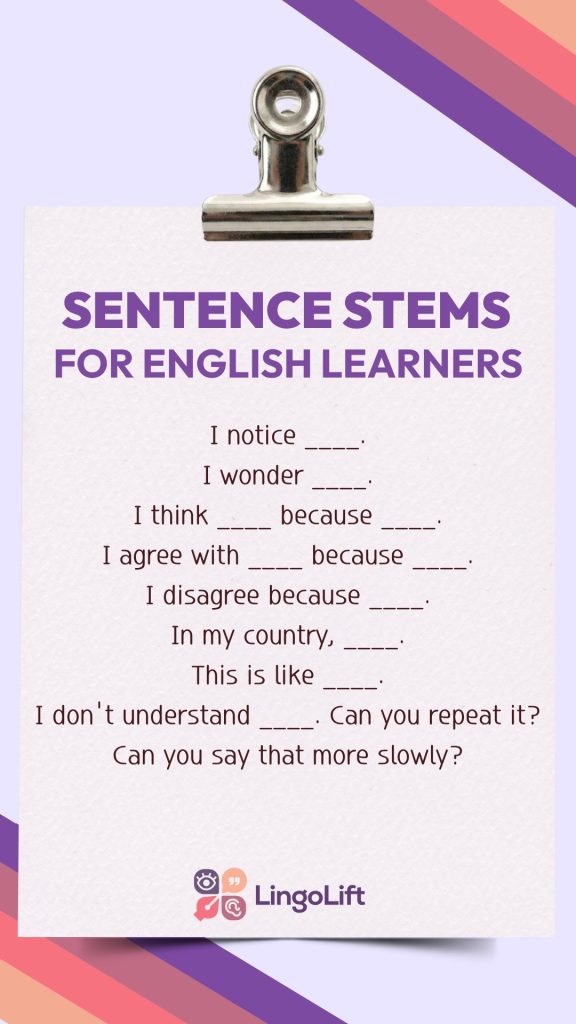
Newcomer sentence stems for your classroom
Here are the key sentence stems we recommend as anchor charts for your multilingual learners. These give students the opening, and let them supply the rest. Post these wherever they are visible and refer to them often:
- I notice ______.
- I wonder ______.
- I think ______ because ______.
- I agree with ______ because ______.
- I disagree because ______.
- In my country, ______.
- This is like ______.
- I don’t understand ______. Can you repeat it?
- Can you say that more slowly?
Repeat and extend
A student says three words. You say the full sentence back, naturally, with the missing pieces supplied, and invite them to repeat it. They keep the meaning and gain the structure without extensive correction or interruption.
Do not correct mid-sentence
Recast instead. If a student says he go to the store, you reply yes, he goes to the store, and then what?
Actually wait
Count to ten seconds after asking a question. Ten seconds is much longer than it feels; if you don’t count, you might wait just one or three. But getting comfortable with that silence is what allows the student time to assemble the sentence.
Choral response
Whole-class repetition gives silent-period students a way to produce English with no exposure at all. It is a low-cost habit and it works.
After the lesson, check understanding across four domains
Comprehension checks should let students show you what they understood without requiring polished English to do it.
Adapt think-pair-share
During the think stage, let students draw or write in their home language. Then pair to compare. Then share out with a stem.
Structure “the gist”
In pairs, students answer three questions:
- What is the subject of the story? Who or what is it about?
- What is the most important thing the story says about the subject?
- What is the gist? (The subject, plus what the story says about it.)
Pairs share their gist statements and the class works toward one agreed version. This produces a main-idea skill that transfers to every text they meet across ELA, science, social studies, and beyond.
Chalk talk gallery walk
Post open questions on chart paper around the room. Students circulate and respond silently, in words, symbols, pictures, or any combination. Then discuss aloud, asking students to summarize what they saw others write. The silent stage removes the speaking risk and the discussion stage restores the speaking practice, once students have something prepared to say.
Utilize cloze sentences
Ideal for students who need more structure than an open question gives. This is where students find the best words to complete a sentence, offering the same comprehension with less production load.
Accept written responses in the home language
A student who writes a full, correct answer in Spanish or Urdu has demonstrated an understanding of the content. A student who writes nothing in either language has not. Without this option you cannot reliably tell those two students apart.
Role play and interviews
For low-stakes formative assessment, have students interview each other about the topic using the target structure. You listen and note who has the form.
A note on translanguaging
When your goal is to bring a newcomer to a working level of English quickly, letting that student move between languages can feel a lot like a concession. It’s not. Allowing that flexibility is an instructional strategy: just note where you’ve offered it as a way to be intentional, interactive, and inclusive.
Translanguaging is also distinct from translation. Its value comes from students drawing on everything they know to make meaning, not from word-for-word conversion.
How do you grade a newcomer?
Teachers often feel trapped when report cards are due: a standard test can result in an unfair failing grade, but passing a student also feels like a disservice. The reality is that a newcomer who fails a grade-level biology test written in complex English didn’t fail biology. They failed an English reading test.
Here is how to assess what they actually know.
Separate content from language.
Look back at the two objectives you set for the lesson. Did the student demonstrate understanding of the content, even if the language form was heavily scaffolded? If they can accurately map the water cycle by drawing and organizing images, they met the science objective.
Assess the growth, not just the standard.
Start a physical or digital portfolio on day one. Keep that very first writing sample, even if it’s just a copied name and a drawing. When grading time comes, evaluating the distance they have traveled is often a more accurate and equitable measure of learning than holding them to a static, native-speaker rubric.
Test in the home language for pure content.
If you need to know whether a student understands a math concept or a historical timeline, and you have the district resources or translated materials to offer the assessment in their home language — do it!
Know your district’s legal policy.
Grading guidelines for multilingual learners vary wildly. Some districts mandate pass/fail or “satisfactory/needs improvement” for the first year of arrival, while others require standard letter grades with documented accommodations. Ask your administration or EL department exactly what is legally required on the report card.
Start Monday
Go back to the student who arrived in October. By Friday she knows how to ask for the bathroom, and you can say her name correctly. She has a buddy and a schedule on the wall she can read without English. You still don’t know what grade she finished, but you’ve asked the registrar and left a message with the family liaison.
That’s one week, and it’s enough to start. The rest builds slowly, which is the correct speed. One short text worked properly. Three passes, three purposes. A stem on the wall and ten seconds of silence after you ask the question. None of this requires a new curriculum, and all of it goes faster with materials built for the job.
What to look for in newcomer-friendly materials
Whether you are a classroom teacher advocating for better tools or a district leader evaluating new curriculum, you need resources built for this specific population. Here is the checklist we use when designing LingoLift, which you can use to evaluate any newcomer platform:
✔ Age-appropriate content at accessible language levels, rather than elementary material for teenagers
✔ Audio and video, so you can vary the access point
✔ Read-along transcripts on everything, plus captions
✔ Instructions available in students’ home languages
✔ Activities tagged to both English proficiency level and grade, so you can find the right thing in under a minute
✔ Practice across all four domains, with speaking included rather than assumed
✔ Resources and teacher guides you can adapt
✔ Compatibility with whichever English language development framework you use, whether WIDA, ELP, or your state’s own
✔ Accessibility that holds up: WCAG 2.2, screen-reader friendly, captioned
✔ Lessons designed for newcomers from the start, rather than general lessons made easier
LingoLift is designed with newcomers in mind
Alongside a library of over 3,000 lessons spanning ELA, ESL, social studies, science, math, and SEL for grades 2–12, we created newcomer lessons built specifically for survival English through intermediate levels.
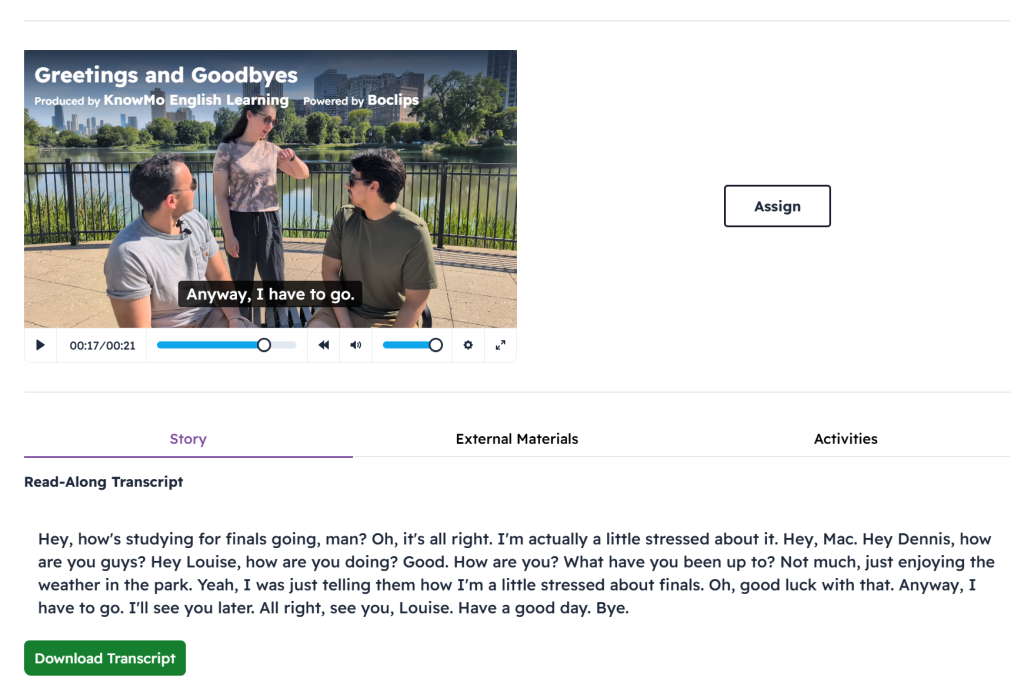
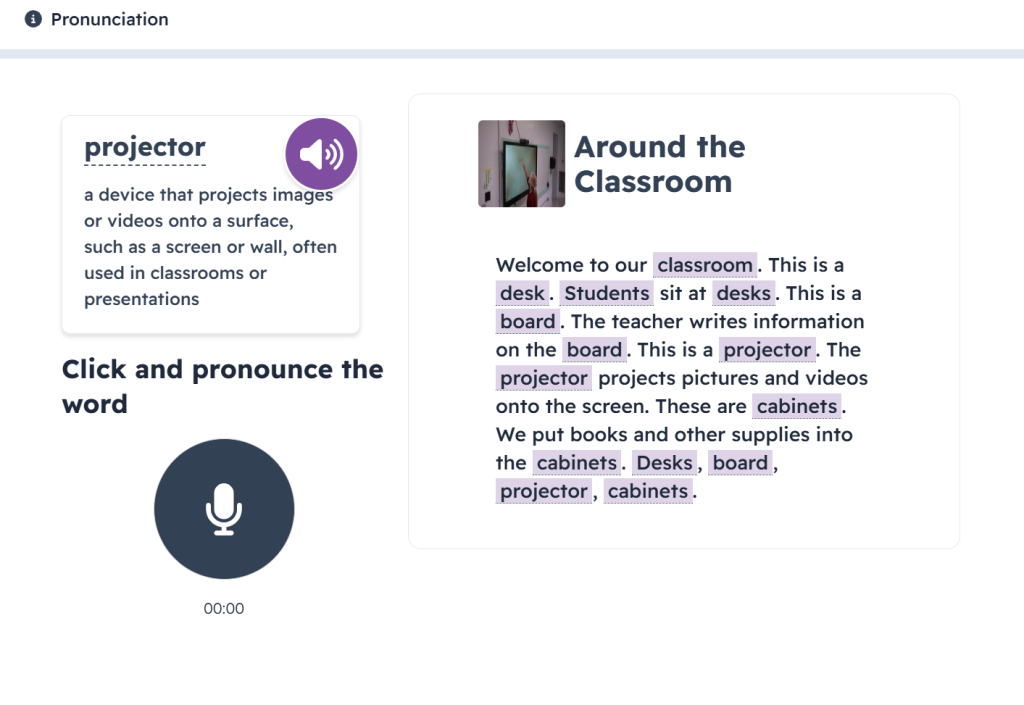
We’ve created 100+ (and growing!) newcomer lessons. All lessons feature video or audio from brands like PBS, TED-Ed, Complexly, Wonderscape, or our own custom produced videos. Typically under 60 seconds, comprehensive interactive activities are attached to each lesson. Topics cover survival English to social vocabulary, with the essential language of school, food, family, and daily life.
Directions and instructions are available in multiple home languages, ensuring that a lack of English comprehension is never a barrier to understanding the task.
FAQ
What is the silent period in second language acquisition?
The silent period is a normal stage of language learning where a student actively listens and absorbs English but does not yet speak it. Depending on the student’s age, personality, and affective filter, this phase can last anywhere from a few days to six months or more.
What is the difference between a newcomer and a SLIFE student?
A “newcomer” generally refers to any multilingual student who has arrived in a new country within the last one to three years. A SLIFE student (Student with Limited or Interrupted Formal Education) is a newcomer who also has a gap of two or more years in their native-language schooling.
How do you teach a newcomer who speaks zero English?
Start by teaching immediate survival vocabulary (bathroom, water, help) using visual aids, gestures, and translated tools. Focus on creating a safe, predictable classroom routine, assign a reliable peer buddy, and prioritize listening comprehension rather than forcing the student to speak in the first few weeks.
What is the best curriculum for newcomer ELLs?
The most effective newcomer curriculum provides age-appropriate content at accessible language levels. Instead of giving high schoolers elementary-level worksheets, the best platforms — like LingoLift — use engaging video, read-along transcripts, and home-language support to build both decoding skills and language comprehension simultaneously.
Leave a Reply